
Baltimore counts roughly 15,600 vacant properties, and only about 1,350 belong to the city. Everything else has a private owner whose name still sits on a deed. Some inherited a rowhouse they’ve never walked through. Others saw their house condemned after a kitchen fire and froze, and I’ve seen that same paralysis firsthand.
If a placard went up and your house is now condemned, you didn’t lose the property. You lost the ability to use it the normal way, and that difference is worth real money.
Can You Sell a Condemned House in Maryland?
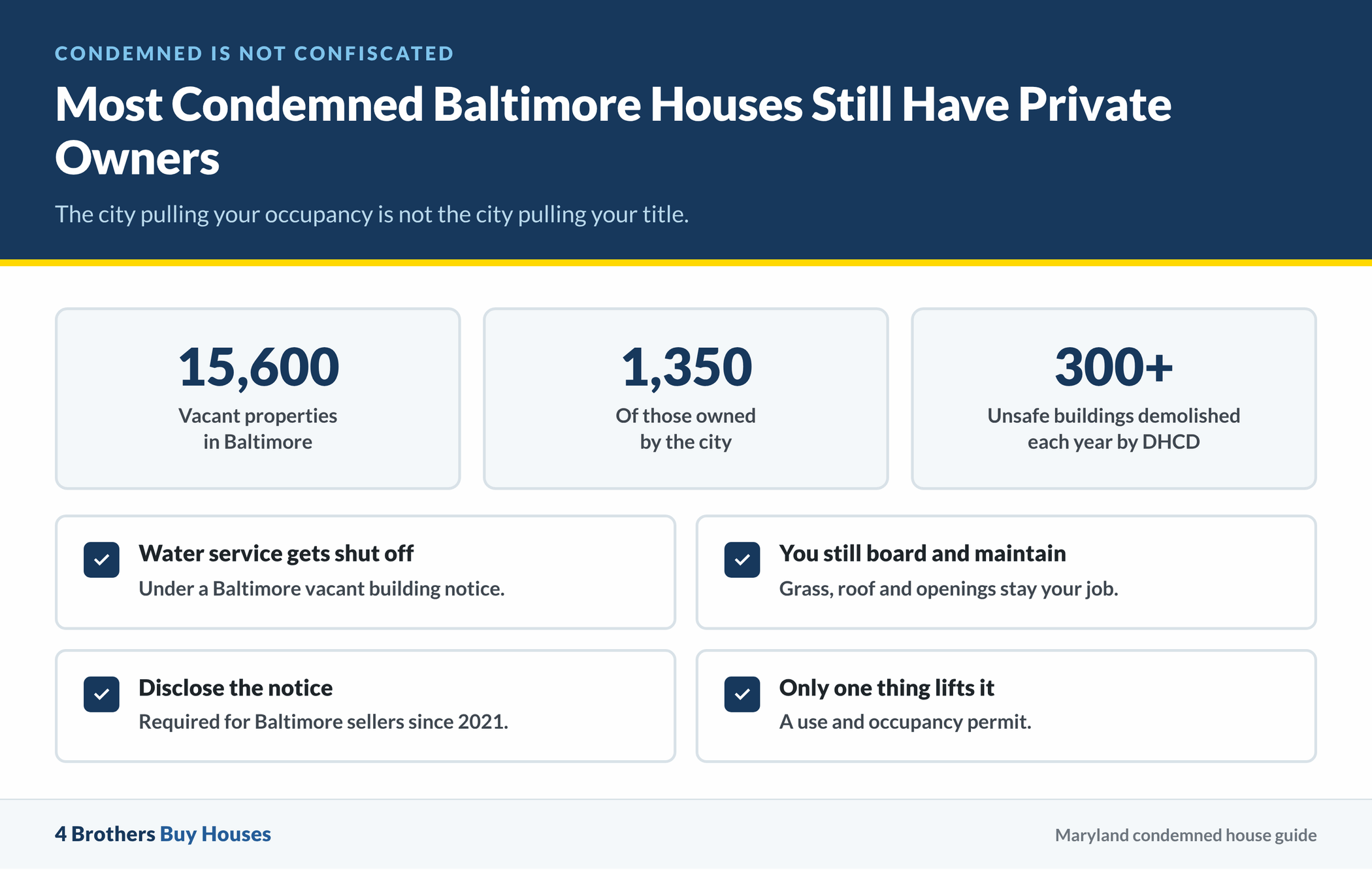
Yes, you can sell a condemned house. The city pulling your occupancy isn’t the city pulling your title, and I’ve explained that at plenty of kitchen tables.
A condemned house is one a building official found unsafe or unfit to live in. That’s different from eminent domain, where the government takes ownership and pays you. Under the Baltimore City Building Code’s condemnation provisions, the official can order immediate demolition if rehab isn’t realistic. When the city has to demolish a building itself, the cost usually becomes a lien on the property. Short of that, the owner of a condemned house keeps the right to sell, transfer and negotiate.
In Baltimore, this usually arrives as a vacant building notice. The house is then treated as condemned, the water gets shut off, and you stay responsible for boarding, mowing and keeping the roof tight. Only a use and occupancy permit lifts it. Since 2021, Baltimore sellers have had to disclose that notice to buyers, and skipping it invites a lawsuit after closing.
What changes is your buyer pool. A conventional mortgage won’t fund a condemned house with no water and an open roof. Lenders need habitability, appraisers need comparable sales, and insurers need a structure they’ll cover. Take those away and you’re left with cash buyers, rehabbers and investors who price risk for a living.
How Does Condemnation Affect a Maryland Home’s Value?
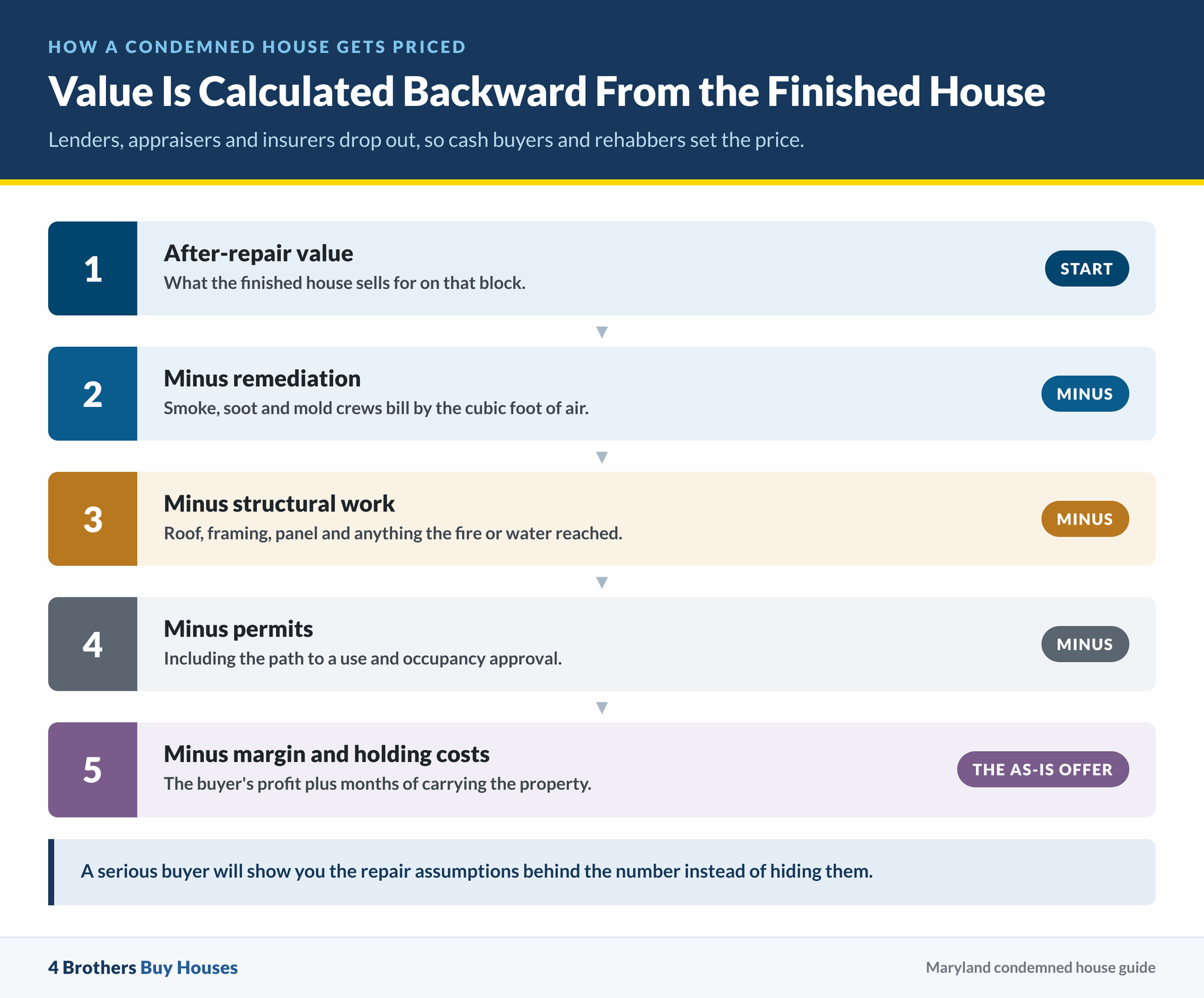
A Maryland condemnation order doesn’t change what the lot is worth. It changes who can buy it and how they price it. Every buyer starts from the finished value and subtracts everything standing between the placard and a use and occupancy permit.
When a fire caused the condemnation, smoke prices the house more harshly than flame. A fire in one bedroom can leave soot in the ductwork, insulation and wall cavities of every room. Water from the hoses soaks into subfloor and drywall, and in a humid Mid-Atlantic summer mold shows up within days. I’ve walked condemned houses in July where the fire was in March and the mold was the bigger line on the estimate.
The median Maryland home sold for about $428,768 in September 2026, according to Redfin’s state market data. A condemned house sits nowhere near that, with or without fire. Its value works backward from after-repair value, minus remediation, structural work, permits, open fines and the rehabber’s margin.
If insurance is involved, the payout can make or break the sale of a condemned property. Dwelling money usually goes to the mortgage holder first, and the lender may release it in draws as work gets done. Get the full scope and any depreciation holdback in writing before you take an offer seriously. Reconcile the claim file too, since an advance a prior owner collected isn’t coming twice.
Is It Worth Fixing a Condemned House Before Selling?
A condemned Dundalk rowhouse came to us with a caved porch roof. The heir’s contractor priced a full renovation on a six-month schedule. She sold it as-is in under three weeks and put the rehab money toward her mother’s care.
Fixing a condemned house first works when three things line up. You have cash that isn’t borrowed at hard-money rates, you can pull permits without a code fight, and the neighborhood supports the finished value. Lose any one, and the spread disappears.
Finished houses do well here. The median Baltimore County single-family home sold for about $410,000 in September 2026, spent roughly 13 days on the market and closed near 103 percent of list. Getting from condemned to finished, though, means permits, inspections, a use and occupancy approval and a contractor who returns calls.
Partial repairs usually waste money. Patching one bathroom in a condemned home that needs a roof and mold remediation doesn’t move the offer. Fix whatever is actively destroying value, like a failed roof or an open sewer line, and stop there. Leave the full renovation to the buyer.
What Are Your Options for Selling a Condemned House Fast?
Baltimore’s median sale price ran near $230,000 for the three months ending September 2026, per Redfin’s city figures. A condemned house won’t follow that curve, but every cash offer traces back to what the finished version is worth.
You have four paths with a condemned house. List as-is with an agent who markets to rehabbers, sell directly to a local cash buyer, try a real estate auction, or hold it and pay the fines. Auctions work for clean title and a crowd. They’re rough for a condemned rowhouse on a quiet block.
Direct cash sales skip the parts that usually sink these sales: no appraisal, no habitability certificate and no buyer walking at inspection. Companies like 4 Brothers Buy Houses buy condemned houses across the state, and a serious buyer will show you the repair assumptions behind their number.
Ask any buyer of a condemned house two questions. Are you closing with your own funds or assigning the contract? And what happens to my price if the title search finds a lien I didn’t know about?
What If Your Condemned House Is Also in Foreclosure in Maryland?
A condemned house can land in foreclosure at the same time, and the two clocks run separately. The code case moves through the city or county while the lender’s case moves through the courts, and neither one waits for the other. Plan for both.
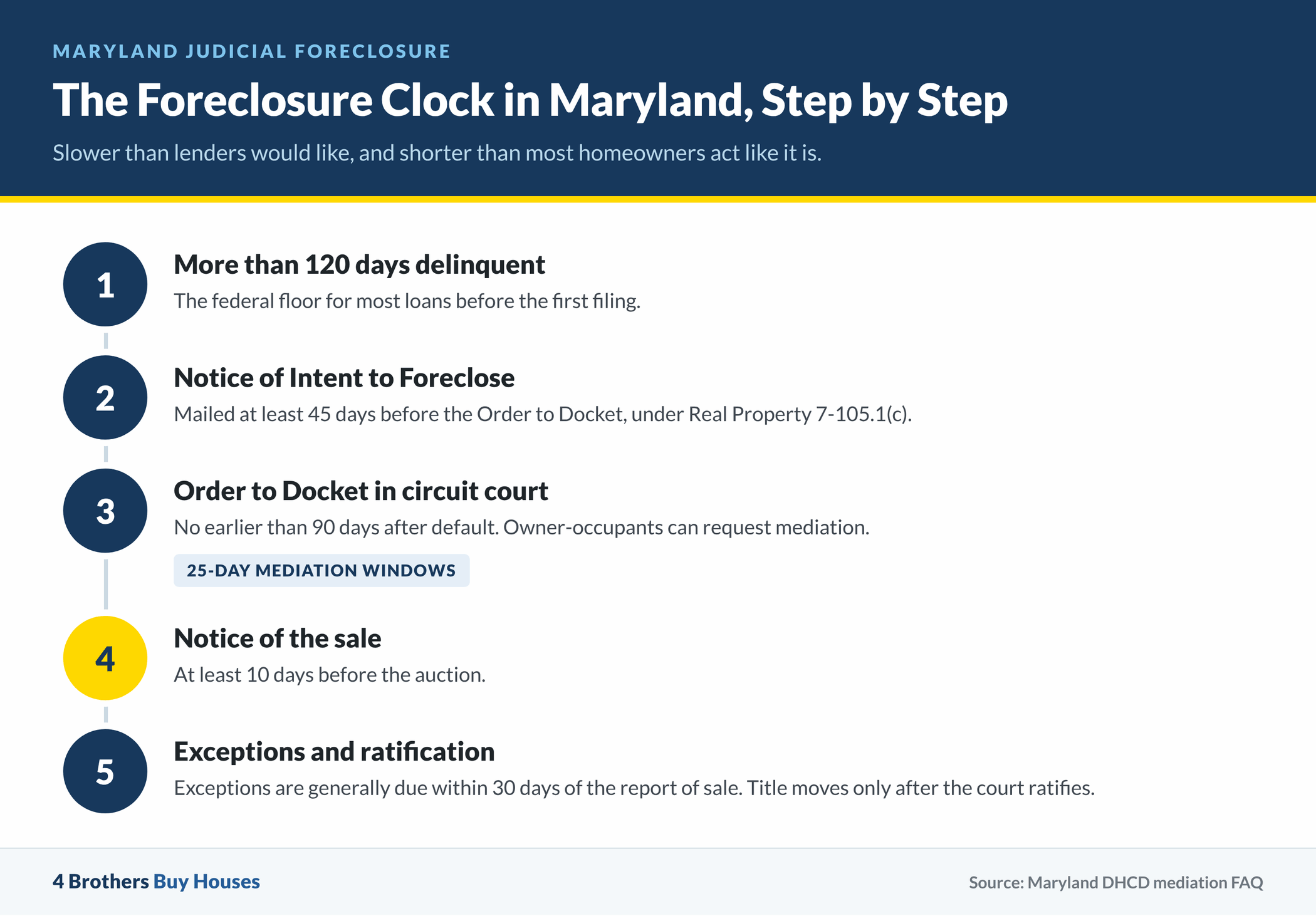
Maryland’s foreclosure system is slower than lenders would like and shorter than most homeowners act like it is. It starts with missed payments, not the court. For most mortgages, a servicer generally can’t file until the loan is more than 120 days behind. The state adds its own rules on top. Your lender has to mail a Notice of Intent to Foreclose at least 45 days before filing in circuit court, under Real Property §7-105.1(c).
Foreclosures here are judicial, so the case goes to circuit court where the house sits. Owner-occupants can request mediation, and the Maryland Department of Housing and Community Development’s mediation FAQ walks through the timeline. Prefile and postfile mediation each run on their own 25-day window.
You get at least 10 days’ notice before a sale. Afterward, the court reviews everything, and title doesn’t transfer until the court ratifies the sale. Meanwhile the code fines on a condemned house keep adding up. The pressure is real, too. Maryland posted the fifth-worst foreclosure rate in the country in August 2026, at one filing per 2,530 housing units, based on ATTOM’s state-by-state report.
How Long Can a Condemned House Sit in Foreclosure in Maryland?
For years I told sellers the auction date was the finish line, and that’s wrong in both directions.
A condemned house goes through the same Maryland court timeline as any other, and cases rarely move as fast as the notices make it sound. From the first missed payment to an auction, you’re usually looking at many months. Mediation and loss mitigation review add time, and Baltimore City and Prince George’s County dockets have run slower than smaller counties.
The dangerous part comes after the auction, when an owner assumes there’s still time while the court reviews the sale. Exceptions can generally be filed within 30 days of the notice of the report of sale. Ratification follows, then possession and a separately scheduled eviction.
Waiting still costs you, and it costs more once a house has been condemned, since the fines keep running too. Every month adds attorney fees, advertising costs and interest to your payoff. The owners who come out whole start making calls during the notice stage.
What Rights Do Maryland Owners of Condemned Property Have?
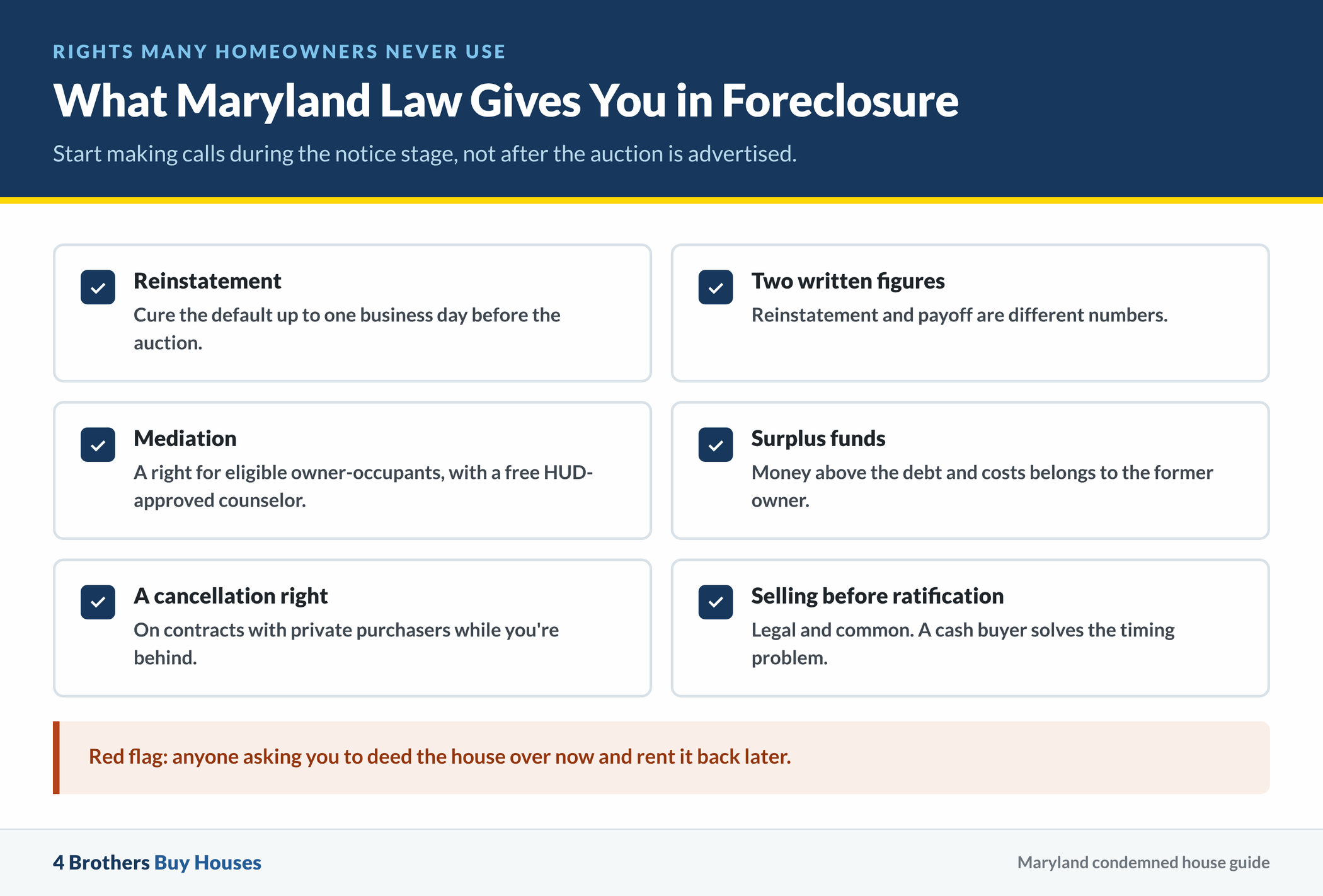
Maryland owners of condemned property keep more rights than most realize, on the code side and the lender side.
A condemnation notice isn’t the last word. Read it for appeal instructions and a deadline, and ask the code office which repairs would lift the order. You keep title, you can still sell, and you can bring the house back with permits and a use and occupancy approval.
If the mortgage is behind too, Maryland wrote foreclosure protections into the law that many owners never use. Reinstatement is often your biggest lever. You generally can cure the default and stop the sale up to one business day before the auction. Ask for a written reinstatement figure and a written payoff figure, since they’re two different numbers.
Mediation is a right for eligible owner-occupants, and a HUD-approved housing counselor will sit in with you for free. If the auction brings more than what’s owed plus allowed costs, the surplus isn’t the lender’s. The court auditor accounts for it, and you can claim it.
State law also regulates foreclosure rescue arrangements, and sellers behind on payments get a cancellation right when they sign with a private buyer. Confirm the current window with a Maryland real estate attorney. Watch out for anyone asking you to deed the house over now and rent it back later. Legitimate buyers pay you at a title company with a recorded deed.
Can You Sell a Condemned House Before a Maryland Foreclosure Sale?
Yes. Selling a condemned house before the foreclosure sale is legal and common, and you can sell any time before the court ratifies the sale. What trips people up is the calendar.
Picture a condemned Maryland property listed with an agent. An offer comes in at day 70, and settlement is set weeks out for the buyer’s mortgage. Nobody asked the trustee to postpone, and the auction doesn’t care about your settlement date.
Get your payoff in writing from loss mitigation and confirm how long it’s good, since interest and fees keep growing. Then ask yourself one question. If your buyer’s financing fell apart next week, could you still close before the sale date? If not, a financed buyer is a gamble with your equity, and most lenders won’t fund a condemned house at all.
Cash buyers solve the timing. A signed contract with a real settlement date sometimes convinces a servicer to postpone, though I’ve seen trustees refuse. Clear liens early too, because an unpaid water bill or old judgment found two days before closing can sink the sale.
Should You Short Sell a Condemned House in Maryland?
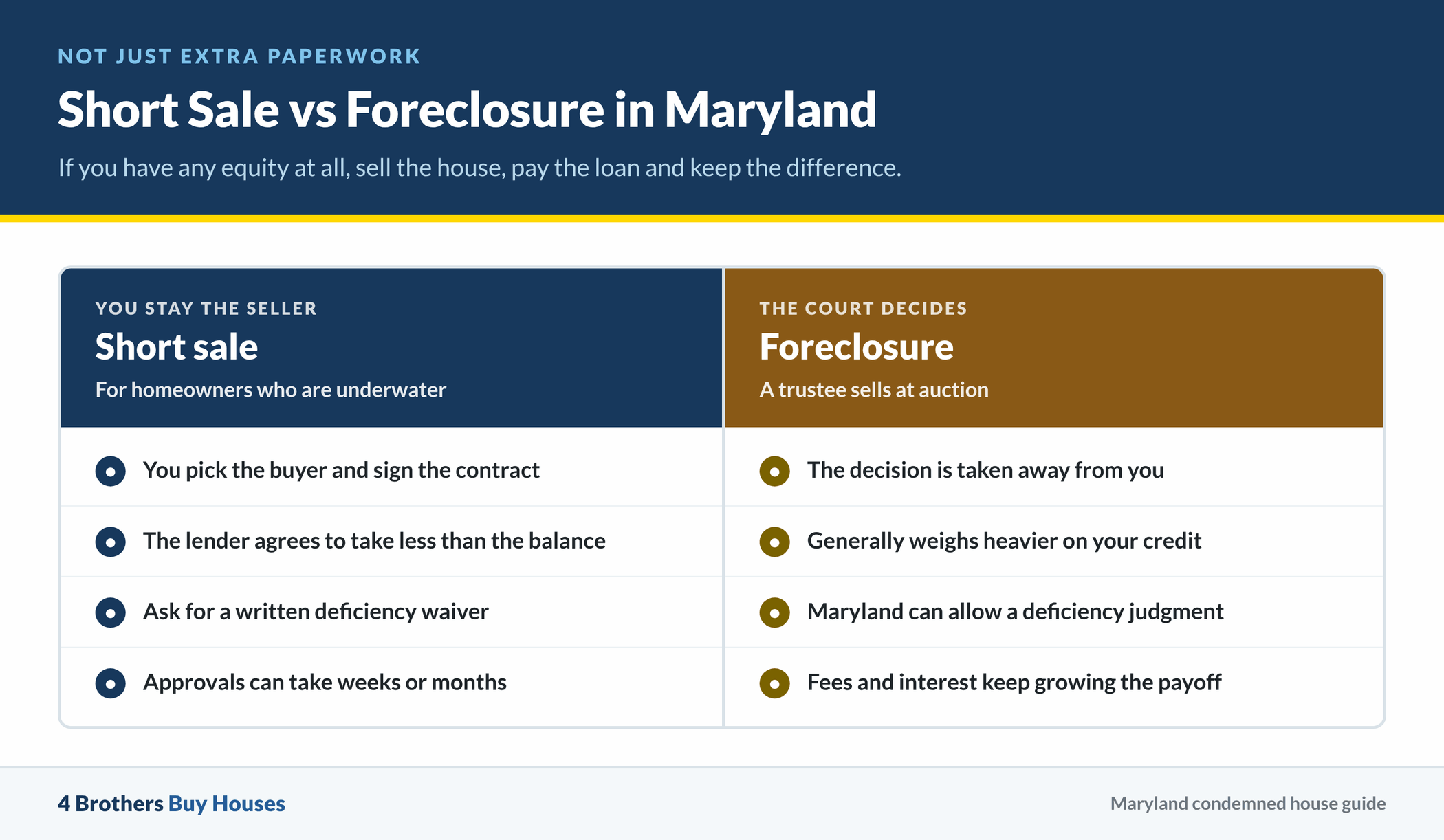
Only if you owe more than the property is worth as it stands. Condemnation pulls value down. A Maryland owner who had equity before the placard went up can end up underwater after it, owing more than any buyer will pay.
In a short sale, you’re still the seller. You find the buyer, sign the contract, and the lender agrees to accept less than the balance. In a foreclosure, a trustee sells the house at auction and the decision leaves your hands.
A completed foreclosure generally weighs heavier and longer on your credit than a negotiated short sale. Courts here can also allow a deficiency judgment for the shortfall in some cases, so the waiver language in your approval letter matters most. Have an attorney read it.
Short sales on a condemned property run on lender timelines, often weeks or months. My honest read: if you have any equity, don’t short sell. Sell the house, pay the loan and keep the difference.
How Do You Sell a Condemned Property Fast in Maryland?
With clean title and a cash buyer, a condemned property can close in two to three weeks. The title company’s lien search and your servicer’s payoff letter usually set the pace, not the buyer’s money.
Gather the deed, mortgage statement, tax bill, any code notices and the insurance policy before you talk to anyone. Price a house that’s been condemned against today’s market, not 2022. Statewide inventory climbed more than 20 percent in September 2026 to 18,748 listings, so buyers have less reason to stretch.
If the house is condemned, vacant or carries code issues, look for a buyer who knows Baltimore DHCD’s construction and demolition division. That office condemns vacant structures and oversees more than 300 demolitions a year. We’ve closed on properties with open citations, and the violations got handled at or after settlement. Be wary of any buyer who won’t put up earnest money or wants an inspection contingency on a house they’ve already walked.
Contents don’t have to slow you down either. A landlord in Hagerstown inherited a duplex packed with thirty years of a parent’s belongings, down to jarred preserves and three broken lawnmowers. We bought it with the contents inside, and he and his siblings split the proceeds without renting a dumpster.
What Are the Tax Consequences of Selling a Condemned House in Maryland?
Selling a condemned house is taxed like any other sale in Maryland. Your gain is the price minus your basis, and a low as-is price often means a small gain or none.
A short sale can bring a surprise. A seller in Glen Burnie closed a short sale and got a tax form in January for the balance her lender wrote off. She hadn’t budgeted a dollar for it.
Forgiven mortgage debt can count as taxable income, though exceptions exist, including insolvency. A CPA costs a few hundred dollars here and often saves much more. Fire losses and insurance proceeds on a condemned house also complicate your basis, so bring the claim file to your tax preparer.
The state withholds 8.75 percent from an individual nonresident seller’s net proceeds at closing, and exemption certificates exist. An inherited condemned house usually gets a stepped-up basis, which often means little or no gain on a quick sale.
Frequently Asked Questions
What Makes a House Legally Uninhabitable?
Your house can be condemned for no running water, no heat, exposed wiring, structural failure, severe mold or a roof that no longer keeps weather out. In Baltimore, an open or boarded vacant building can draw a vacant building notice, which treats it as condemned until a use and occupancy permit is issued.
What Closing Costs Do Sellers Pay in Maryland?
The state transfer tax is half a percent, and counties add their own taxes, split evenly by default. That puts a typical seller’s share around 1.1 to 1.5 percent in the Baltimore and Annapolis markets. If your buyer is a qualifying first-time buyer, the state rate drops to a quarter percent and you pay all of it. Selling condemned property doesn’t change those rates.
What Percent Counts as a Lowball Offer?
Roughly 10 to 15 percent under fair market value, though the number alone says little. An as-is offer can land 20 or 30 percent under retail and still be your strongest, since retail buyers can’t finance a condemned house with no furnace. A true lowball can’t show its math or drops after inspection.
Can I Sell a House with Open Code Violations?
Yes. Violations transfer with the deed, and unpaid citations get paid from your proceeds at closing. You must disclose what you know, and lenders won’t fund a condemned house, so these usually go to cash buyers.
How Fast Can a Distressed Maryland House Actually Close?
Two to three weeks for a cash sale of condemned property with clean title. Unknown heirs, an old unreleased mortgage or an unopened estate can add weeks, so start the title search the day you accept an offer.
Do I Have to Clean the House Out First?
No. Cash buyers of a condemned house expect furniture and full basements, and the cleanout is already priced into the offer. Take the photos and documents that matter, and leave the rest.
If you’re sitting on a house that’s been condemned and needs more work than you want to put in, you don’t have to decide today. Reach out when you want a straight answer on what it’s worth as it stands.
Condemned Houses We Buy in Maryland
A condemned house with open citations and a placard doesn’t stop us from buying. We buy houses in Baltimore, Dundalk and Glen Burnie. The 4 Brothers Buy Houses team buys across our Maryland service area.
Habitable homes have the market to themselves. Redfin counted 5,467 Maryland home sales in August 2026, and the typical house spent 43 days on the market before it went under contract.
Get a Number Before the Notice Runs Out
If a placard or a foreclosure notice has you counting days, contact us and get an as-is cash figure. You can see how our process works with a condemned house and violations still open. Fill out the form below to send us the address.
Helpful Maryland Blog Articles
- Selling Partial Ownership Of A House In Maryland
- How Much Does a Realtor Charge to Sell a House in Maryland
- How to Sell a Condemned House in Maryland
- Selling a Rental Property in Maryland
- How Much Does It Cost to Stage a House in Maryland?
- How to Sell a House With Foundation Issues in Maryland
- Selling a Fire-Damaged House in Maryland
- How Long Can Sellers Stay In Your Home After Real Estate Closing
- Can a Seller Refuse Repairs After a Home Inspection
- Selling a House That Needs Repairs in Maryland
- How Does Selling A House with A Mortgage Work in Maryland