

A Maryland house doesn’t pass to the kids the second a parent dies. Legal title to the inherited house lands with the estate, and until the Register of Wills puts someone’s name on paper, no one can sign a deed a title company will insure. Grief runs on no schedule. The mortgage statement runs on its own.
That gap between the funeral and the first real decision is where most inherited property problems start. Bills keep arriving, the lawn keeps growing, and nobody is quite sure who’s allowed to make a call. The steps below come from the inherited houses we’ve bought across Maryland and the questions heirs ask us most.
What Should You Do First With an Inherited House?
Lock the inherited house down before you sort anything. Change the locks or at least collect every spare key, because neighbors, caregivers and old contractors often have one. Take photos of every room and the yard. Those pictures help with insurance, with the estate inventory and with any dispute later about what was inside.
Call the homeowners insurer next. Tell them the owner died and the home is empty, then ask what coverage stays in place and for how long. Keep the utilities on so pipes don’t freeze, and forward the mail to whoever is handling the estate.
Find the will if there is one, since it usually names who handles the inherited estate. The original belongs with the Maryland Register of Wills in the county where your parent lived, and the state expects it filed promptly after the death even if nobody opens the estate right away. Don’t move valuables, sell the car or empty the bank account yet. Until someone has legal authority, every move with inherited property is a risk to you personally.
Keep a simple log of what you pay out of pocket for the inherited house. Mortgage payments, utility bills and a locksmith all count, and the estate can usually pay you back once it’s open.
When Does the Personal Representative Get the Power to Sell?
Three siblings called me last year from Dundalk, three months behind on their mother’s mortgage with an auction date already set. Her garage still held bowling trophies and a riding mower that hadn’t started in years, and not one of them lived in the state anymore.
No clever negotiating saved that inherited house. It was getting one sibling appointed quickly as personal representative, then selling it as-is before the auction date, trophies and mower included. We closed the whole sale in five weeks.
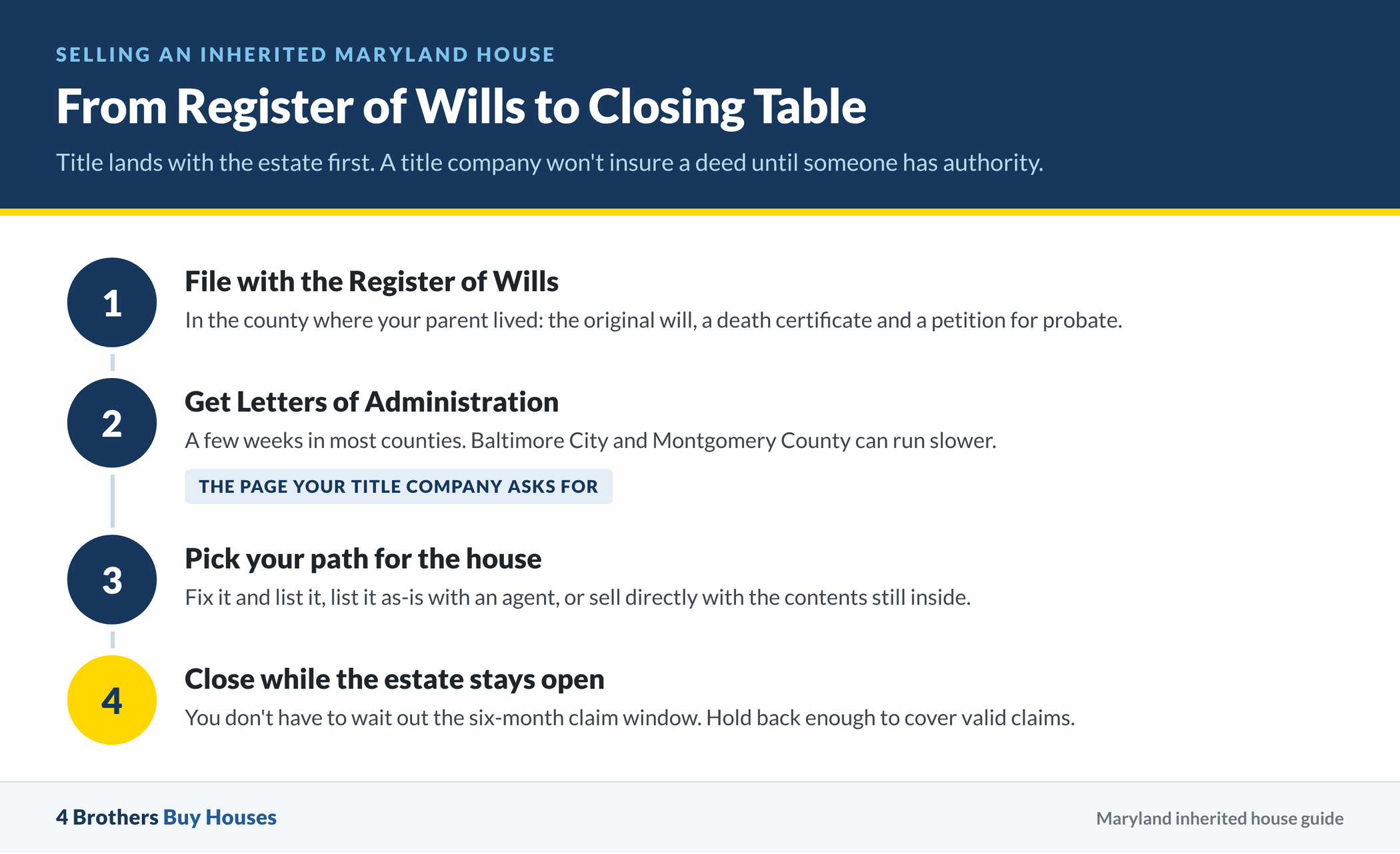
Authority comes from the Register of Wills in the county where your parent lived. Filing requires the original will, a death certificate, and a petition for probate. Letters of Administration are issued by the court, and a title company will ask for that single sheet of paper before it insures the sale. Without it, a signed contract is just a wish.
A straightforward appointment turns around in a few weeks in most Maryland counties, though Baltimore City and Montgomery County can run slower. Being named personal representative in a will gives you the inside track. With no will present, Maryland law sets the order of priority, and surviving children usually sit near the top.
Living out of state doesn’t disqualify you from settling a Maryland estate. Out-of-state heirs take on the role regularly. The Register may ask you to name a Maryland resident agent who can accept legal papers for the estate, and some estates need a bond unless the will or the heirs waive it. Ask the clerk which forms apply before you file, since a missing page can stall the appointment.
Small Estate or Regular Estate?
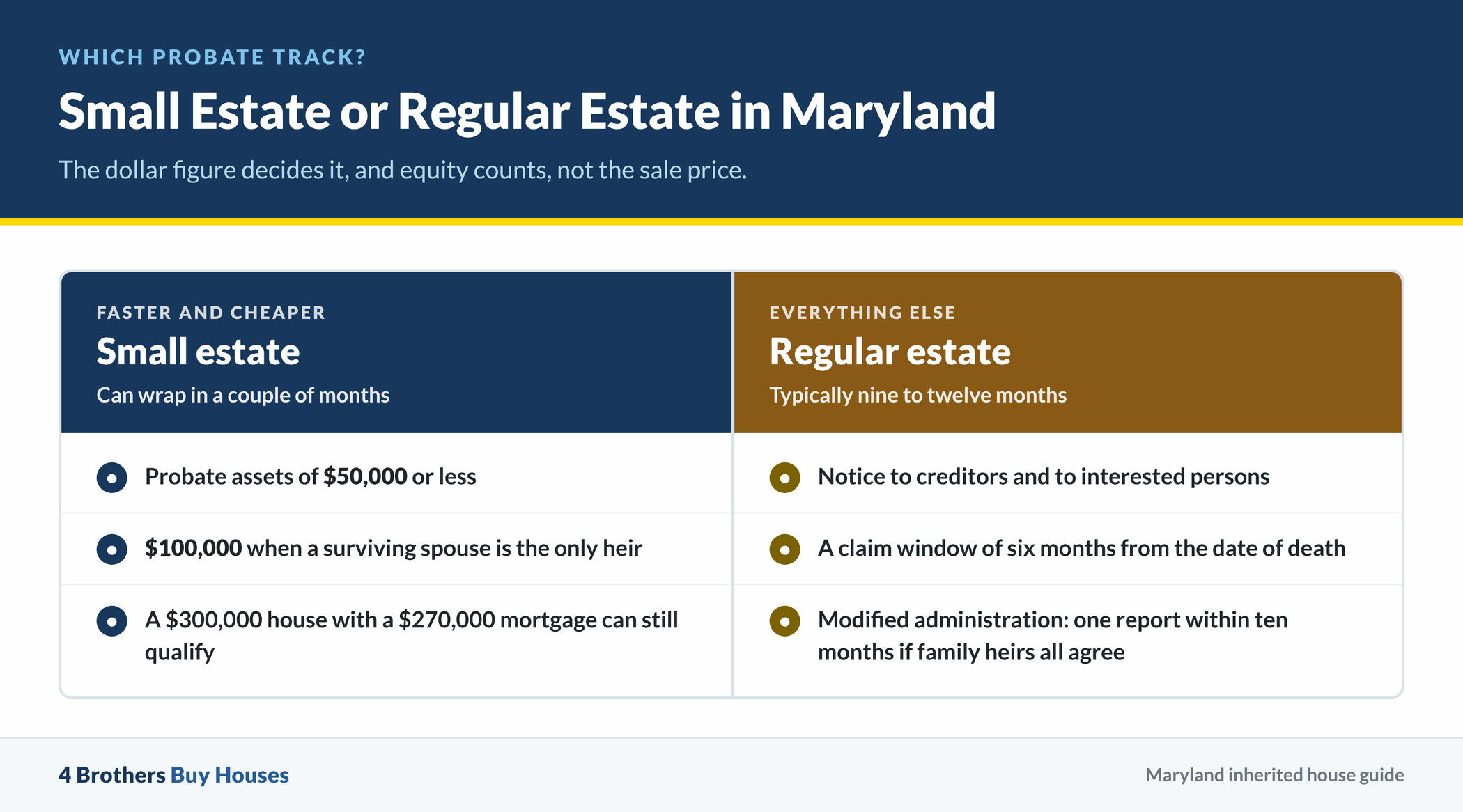
Which track you’re on gets decided by the dollar figure. A small estate proceeding, faster and cheaper, is allowed in Maryland when the probate assets total $50,000 or less. That number climbs to $100,000 when a surviving spouse is the only heir. Equity counts, not the sale price, and I’ve seen heirs assume otherwise, so a house worth $300,000 with a $270,000 mortgage can still qualify.
Everything else is a regular Maryland estate. Publish notice to creditors, send notice to interested persons, and keep the claim window open for six months from the date of death. People often assume they must wait out those six months to sell the inherited house, and that’s not true. You can list, contract, and close while the estate stays open, as long as you hold back enough from the proceeds to cover valid claims.
You can also ask the Register about modified administration. If all the heirs are family and everyone agrees, it cuts the formal accounting down to a single report filed within ten months. Less paperwork, fewer filing fees, same authority to sell.
What Does a Regular Maryland Estate Look Like Step by Step?
Most Maryland families with an inherited house end up in a regular estate, because the equity alone clears the small estate limit. The order of filings is predictable once you see it laid out. Maryland’s People’s Law Library walks through the full timeline, and the short version looks like this:
- File the will and a petition for probate with the Register of Wills.
- Receive Letters of Administration once the personal representative is appointed.
- File the list of interested persons within 20 days of appointment.
- File the inventory and information report within three months of appointment.
- Wait out creditor claims, which run six months from the date of death.
- File the first account within nine months of appointment.
Selling the inherited house can happen anywhere after step two. The inventory lists the property at its date-of-death value, so the appraisal you order for taxes does double duty here.
Here’s a mild opinion from watching dozens of these. Maryland families who sell early in the process usually spend less, argue less and close the estate faster. A house sitting in the inventory for a year turns every later account into a running tally of utility bills.
The House Nobody Wants to Clean Out
Fifty years of living fills a Maryland rancher. Basements in Anne Arundel County flood, and attics in Hagerstown hold boxes nobody has opened since the Carter administration. The roof your dad patched himself in 2009 is now a line item on a buyer’s inspection report. I’ve watched that kind of line sink a sale at the closing table.
Three realistic paths forward exist here. Fix it up and list it on the open market, which brings the highest price and the longest timeline plus money out of pocket. List it as-is with an agent and accept that buyers will discount hard for the unknowns. Or sell directly to a cash buyer who takes the inherited house with the contents still inside.
How far away you live, how much the estate has in the bank, and whether the mortgage, taxes, and insurance are current determine the right answer. A vacant house in Maryland costs money every month it sits, and I’ve seen heating bills alone drain an estate’s cash fast. Homeowners insurers also cancel vacancy coverage quickly, often after 30 or 60 days, and an uninsured estate property is a genuine risk.
Sort the inherited contents before you haul anything. Pull out the paperwork first: deeds, tax bills, bank statements, insurance policies and anything with a lender’s name on it. Then let each heir tag the few items they truly want. A cleanout crew or a cash buyer can handle the rest, and nobody spends six weekends renting a dumpster.
What Does It Cost to Hold an Inherited House in Maryland?
More than most heirs budget for. An empty inherited house still runs a property tax bill, a water bill, electricity, heat in winter and lawn care in summer. Add the mortgage if there is one, plus the insurance, which often costs more once nobody lives there.
Maryland counties bill property tax every year whether anyone lives there or not. Leave that bill unpaid long enough, and the county can sell the tax debt on the inherited house to an investor at its annual tax sale.
That’s a mess to unwind, and the fees stack up fast.
Small problems get bigger in an empty inherited house, too. A slow leak under a sink can run for weeks before anyone notices. A Maryland winter with the heat off can split a pipe in a single night. One burst line in January can turn a quick sale into a gut job.
Add up a month of carrying costs before you decide anything. Multiply it by how long a repair and a listing would really take. That number is the honest price of holding inherited property, and it often settles the fix or sell question on its own.
How Do You Price an Inherited House in Maryland?
Start with the date-of-death appraisal. A licensed Maryland appraiser values the inherited house as of the day your parent died, which sets the tax basis and fills the estate inventory. It isn’t the same as a listing price, though it’s a fair anchor.
Next, look at recent sales of similar homes within a mile or so of the inherited property. Match the age, the size and the condition as closely as you can. An inherited house with original kitchens and baths won’t sell like the flipped house down the street, and comparing the two only leads to disappointment.
Then subtract what a Maryland buyer will have to fix. Roof, furnace, windows, electrical and plumbing are the big lines. A cash offer on an inherited property works backward from what the finished house would sell for, minus the repairs and the buyer’s costs. Ask any buyer to show you that math.
Should You Fix Up an Inherited House Before Selling?
Usually only if the repairs are small and the Maryland estate has cash to spare. Paint, carpet and a deep clean can pay for themselves on a house that’s otherwise sound. A roof, a furnace or a failing sewer line rarely does once you add the months of carrying costs.
Think about who pays and who decides. Every repair dollar on inherited property comes out of the estate, which means it comes out of every heir’s share. One sibling who wants a full kitchen remodel is asking the others to fund a project they may not believe in.
There’s also the calendar. Contractors in Baltimore County and Prince George’s County book weeks out, and permits add more time on top. Each month an inherited house sits under construction is another month of taxes, insurance and utilities.
Listing the inherited house as-is with an agent is the middle path. You’ll reach more retail buyers, though inspections on older homes tend to turn up a long list, and renegotiation is common. Selling inherited real estate directly to a cash buyer trades some of the top price for speed, no repairs and no showings.
What If the Inherited House Still Has a Mortgage?
An inherited mortgage doesn’t vanish when the borrower dies. It stays attached to the house, and somebody has to keep paying it or pay it off at closing.
Lenders can’t call the loan due just because the owner died, and federal law lets heirs assume the loan or pay it off. Contact the servicer in writing with the death certificate and your Letters as soon as you have them. Ask to be recognized as a successor in interest so the servicer will talk to you about the account.
Missed payments still count. A Maryland foreclosure can move forward on a delinquent loan even while the estate is open, so a sale or a payment plan needs to happen before the notices pile up. When the inherited house is worth more than the payoff, the simplest answer is often to sell it, pay the lender at settlement and split what’s left.
A reverse mortgage works differently. The balance usually comes due when the last borrower dies, and the servicer will set a deadline for the heirs to sell, pay off or settle the loan. Read every letter the servicer sends, since those deadlines are firm.
The Tax Part Is Easier Than You Think

Two things usually worry Maryland heirs more than they should.
Maryland inheritance tax is 10 percent, but children, grandchildren, parents, siblings, and spouses are all exempt. Most families owe nothing. Maryland estate tax doesn’t kick in until roughly $5 million.
Federal estate tax reaches even fewer families. The federal exemption is $15 million per person in 2026, so a typical inherited house in Maryland never comes close.
The house gets a stepped-up basis for capital gains, valued at what it was worth on the date of death, not what your parents paid in 1978. Sell near that value in the first year and the taxable gain is usually small or zero. Get a date-of-death appraisal if you can; it’s cheap insurance against an IRS question later.
Any gain on an inherited house is treated as long-term, even if you sell it a month after the funeral. That keeps the federal rate lower than it would be on a quick flip. A CPA can confirm how the numbers land for your situation.
The one people miss: if the personal representative lives out of state, Maryland withholds tax from the net proceeds at closing under the nonresident seller rules. The Comptroller set the rate at 8.75 percent for nonresident individuals on sales after June 30, 2025. You get it back when you file, though it stings at the settlement table if nobody warned you, and I’ve watched sellers do a double take at that line item. Tell your title company early so they can apply for a reduced withholding certificate.
When the Siblings Don’t Agree
One wants to keep it, one wants to sell yesterday, and one isn’t answering texts.
The personal representative usually has authority to sell without unanimous consent, especially when the will grants a power of sale. Forcing it burns relationships, though. A written payoff schedule, a clear appraisal, and one neutral deadline solve more of these standoffs than lawyers do, something I’ve watched play out firsthand with feuding siblings. If nothing works, any co-owner can file a partition action in circuit court, which ends with a court-ordered sale and attorney fees on both sides. It’s the expensive last resort.
A buyout often settles the dispute. The sibling who wants to keep the inherited house pays the others their share, usually through a new mortgage in their own name. Get the inherited property appraised first, so the number isn’t a fight of its own.
Sometimes one heir has been living in the inherited house. That heir may want to stay, and the others may want rent or a sale. Put any arrangement in writing with an end date, because open-ended “for now” agreements are where Maryland families end up in court.
Frequently Asked Questions
Can I sell the house before probate is finished?
Yes. You need Letters of Administration, not a closed estate. Inherited house sales in Maryland routinely close while the creditor period is still running.
What if the mortgage is behind?
Lenders can’t call the loan due just because the owner died. Missed payments still matter, and foreclosure still moves forward on a delinquent loan. Write to the servicer with the death certificate and your Letters, and plan the sale before the notices pile up.
Do all heirs have to sign the deed?
If the personal representative is selling estate property under a power of sale, usually no. If title already passed to the heirs directly, then yes, every one of them signs.
How long does Maryland probate take?
A small Maryland estate can wrap in a couple of months. A regular estate typically runs nine to twelve months, though the inherited house can sell long before that.
Will a cash buyer take an inherited house with everything still in it?
Most will. Keep the photos and the paperwork from the inherited house, take what matters to you, and leave the rest.
Can I live in the inherited house while the estate is open?
Sometimes, with the personal representative’s agreement and the other heirs’ consent. Put the terms in writing, including who pays the utilities and the taxes, and when the arrangement ends.
What if the inherited house has unpaid property taxes?
The unpaid Maryland taxes come out of the sale proceeds at settlement. Call the county finance office early to get the payoff, and check whether a lien has already gone to tax sale.
Do I need a lawyer to sell an inherited house in Maryland?
Not always. Plenty of Maryland personal representatives handle a simple estate with help from the Register’s staff. Bring in a probate attorney if heirs disagree, the estate owes more than it owns, or the title has old problems.
If you’re holding Letters of Administration and a set of keys to a house three hours from where you live, you don’t have to figure out the next step tonight. When you want a straight answer on what the inherited property is actually worth as-is, and what a sale would look like on your timeline, reach out. No pressure, no obligation, just a conversation whenever you’re ready.
Inherited Houses We Buy Across Maryland
Heirs with an inherited house in Maryland reach us from out of state all the time. We buy houses in Dundalk, Glen Burnie and Baltimore, with the contents still inside. The 4 Brothers Buy Houses team works across our full Maryland service area.
A vacant inherited house competes with plenty of others. Redfin counted 5,467 Maryland home sales in August 2026, and the typical house spent 43 days on the market before it went under contract.
Get a Number on the Inherited House
Once you hold Letters of Administration, you can contact us and get an as-is cash figure for the estate file. You can also see how our process works from walkthrough to settlement. Fill out the form below when you’re ready.