

A Maryland circuit court judge can order that your house be sold as part of a divorce. In the years I’ve spent buying houses around this state, though, I’ve rarely watched one force the issue. Couples almost always settle the house question first.
So no, selling isn’t automatic. “Not required” and “not smart” are different things, and I’ve watched people get both wrong. Some couples fight to keep a home one income can’t carry, then lose it eighteen months later anyway. Others panic during divorce proceedings and sell for far less than the house is worth, losing equity they spent fifteen years building.
How Is Property Divided in a Maryland Divorce?
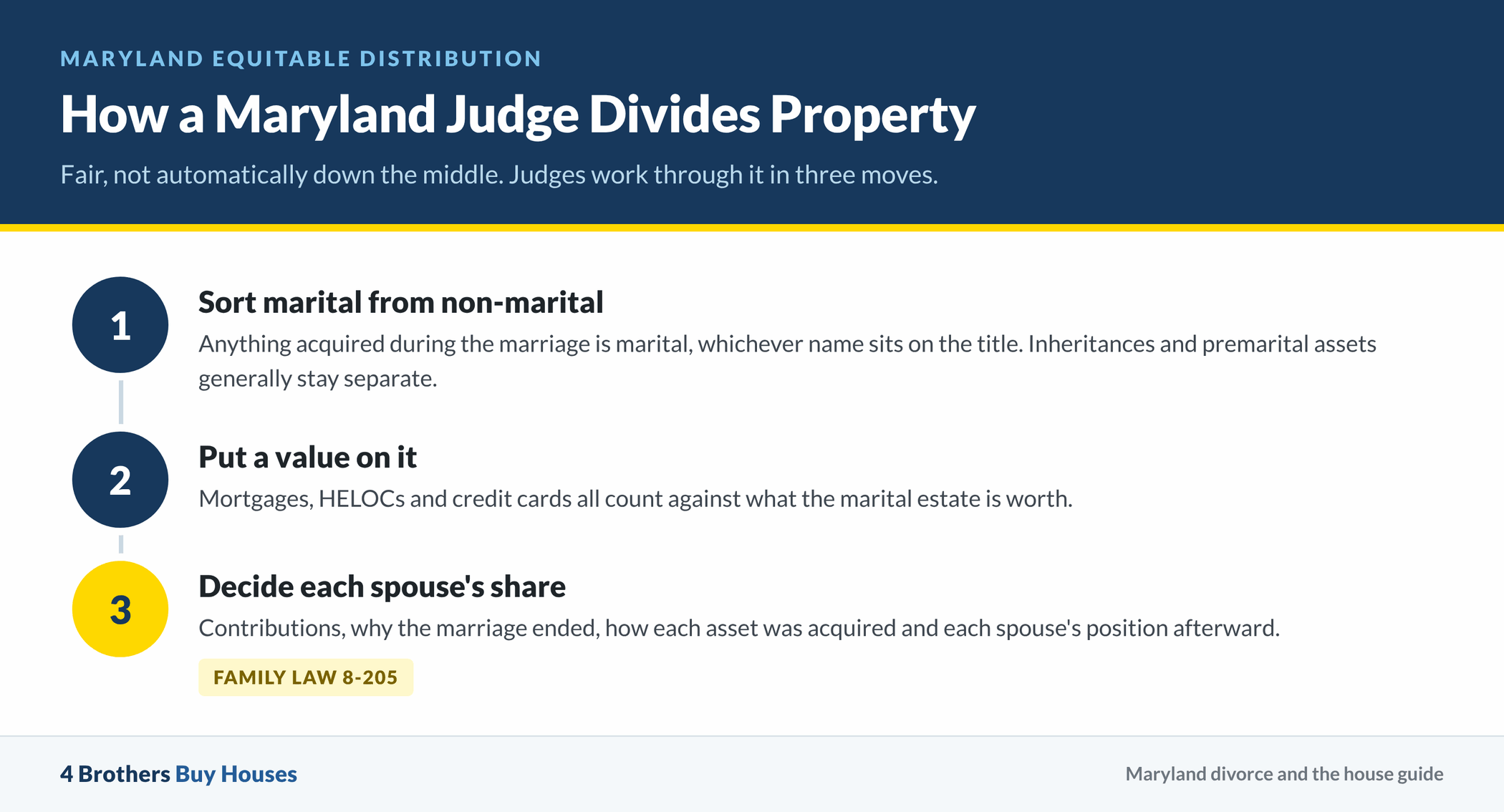
Maryland uses equitable distribution, which means fair rather than automatically half. When spouses can’t reach their own agreement, the Marital Property Act takes over. The Maryland People’s Law Library explains the framework in plain language.
Judges sort what’s marital, put a value on it, then decide each spouse’s share under Family Law § 8-205. They weigh what each person contributed, how each asset was acquired and where each spouse will stand once the divorce is final. A house bought during the marriage counts as marital property even if only one spouse signed the deed. Assets you brought into the marriage or inherited from a relative generally stay separate. Mortgages, HELOCs and credit card balances all count against the estate when dividing it up.
One limit matters before you negotiate. A divorce court generally can’t retitle a house held in one spouse’s name, so it issues a monetary award instead.
Who Gets the House in a Maryland Divorce Settlement?
“My name is the only one on the deed, so it’s my house.” I hear that constantly, and here it’s usually wrong. Most married couples in Maryland hold title as tenants by the entirety, which puts the house squarely in the marital pile.
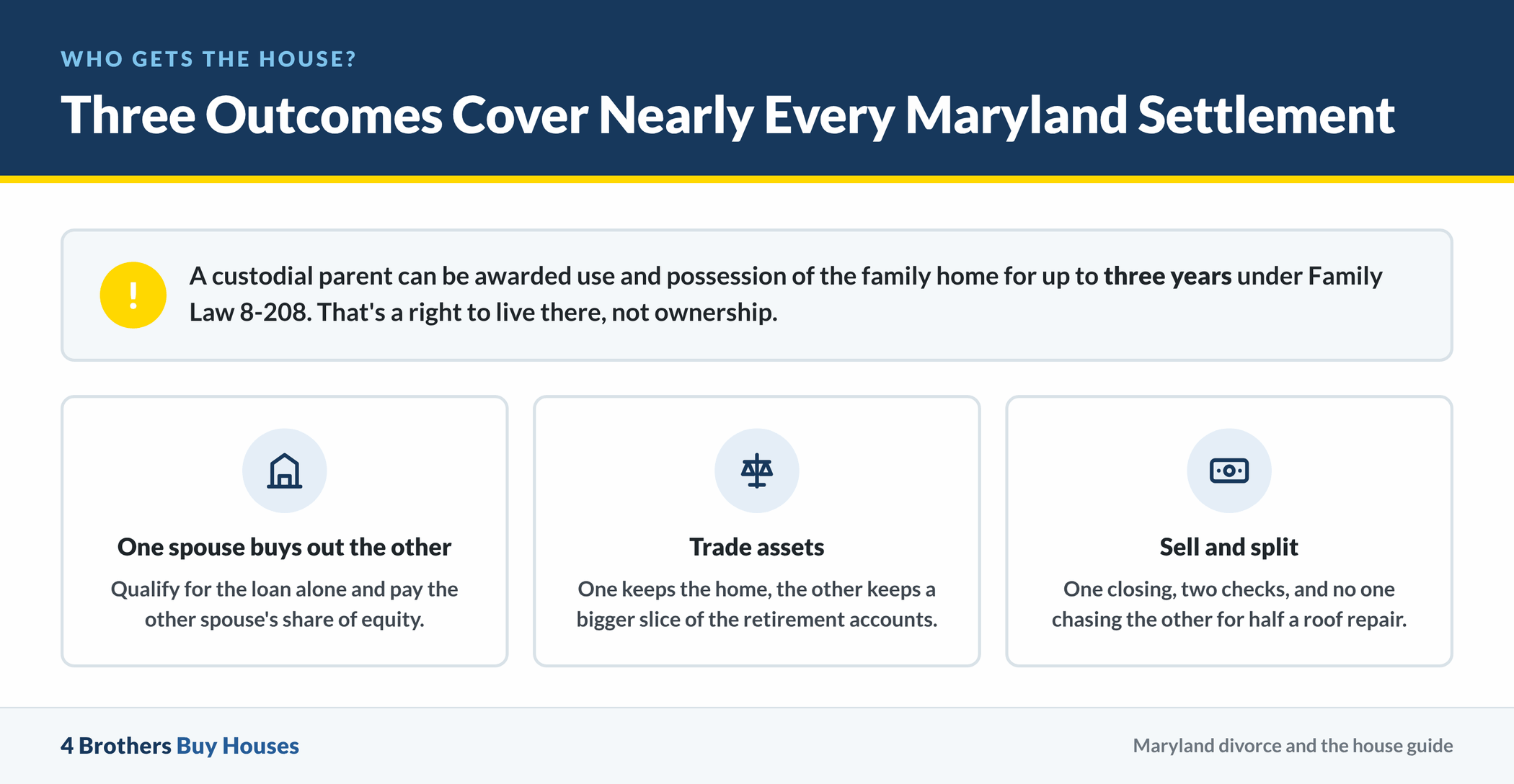
Most of the time, the house goes to whoever the two of you decide. When a judge decides, children carry real weight. A court can give the custodial parent use and possession of the family home for up to three years after the divorce under Family Law § 8-208.
That’s a right to live there, not ownership. Both names can stay on the deed and the loan the whole time. Keeping the house can feel like the loving choice, and sometimes it is. Other times it’s a three-year countdown to a forced sale with less equity.
Do I Have to Sell My House in a Maryland Divorce?
No statute requires it. A court can order jointly titled property to be sold so its value can be divided, but judges treat that as a last resort. Most divorce sales happen because both people choose them.
An heir in Arizona once called me about a cape in Glen Burnie. She’d inherited a half interest in the middle of her own divorce and had no interest in flying back for repairs. We bought it as-is, she signed remotely, and the money went straight into her settlement. 4 Brothers Buy Houses gets that kind of call more often than you’d guess.
Your real options are a buyout, a sale, or temporary co-ownership with a written sale date. Be careful with that last one. It works when both people stay organized and write down who pays what. When they don’t, a shared mortgage keeps two people financially married for years after the divorce is final.
Why Do Many Maryland Couples Choose to Sell the House?
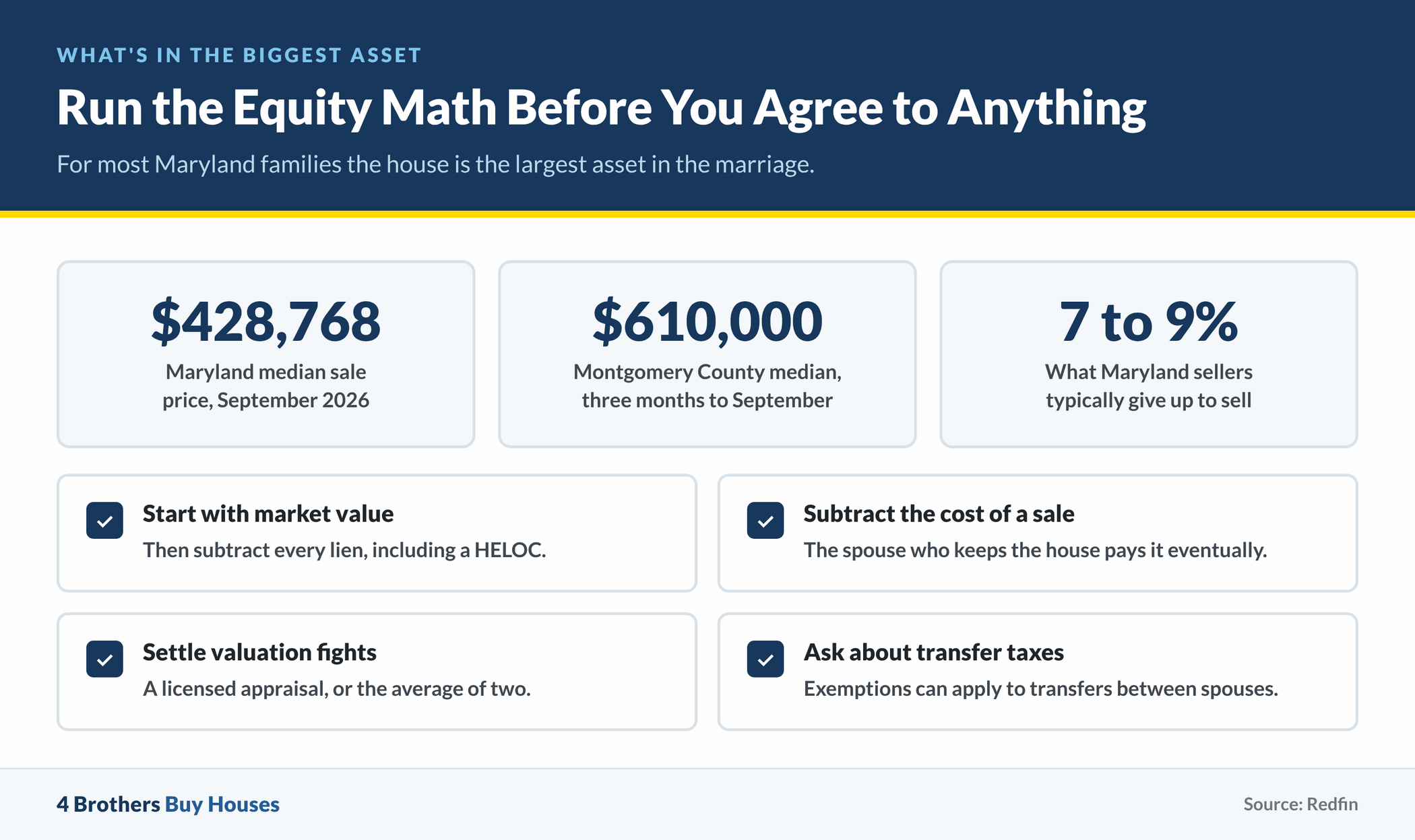
For most families going through a divorce, the home is the biggest asset, and you can’t cut it in half without turning it into cash.
The median Maryland home sold for about $428,768 in September 2026, according to Redfin’s Maryland market data. Montgomery County’s median sale price sat near $610,000, while Baltimore City was closer to $224,500.
Selling also ends the tangle. One closing, two checks, and nobody chasing anybody for half a roof repair in 2029. A payment two incomes handled can swallow one income whole, especially once alimony or child support starts. I’ve watched sellers hang on for a year after the divorce, drain their savings, and sell anyway with less to show for it.
What Happens to the Mortgage During a Maryland Divorce?
Your divorce judgment may say your spouse pays the mortgage. Your lender has never read it. The note is a contract with the bank, and a family court order doesn’t release anyone from it.
If both names are on the loan, a missed payment hits both credit reports. Six missed payments can start foreclosure on a house one of you left a year ago.
Somebody still has to pay while you’re separated. Spouses often split it, or the one living there covers it, or a temporary order spells it out. Put the plan in writing and keep a record of every payment until the divorce is final.
Watch the escrow account, too. Taxes and insurance usually ride inside the monthly payment, and if the policy lapses because nobody updated a billing address, the lender buys force-placed coverage and adds it to your bill. Many Maryland households also carry a HELOC from a kitchen remodel or a tuition year. That second lien has to be handled at closing or in the assumption just like the first.
How Does Maryland’s New Mortgage Assumption Law Work?
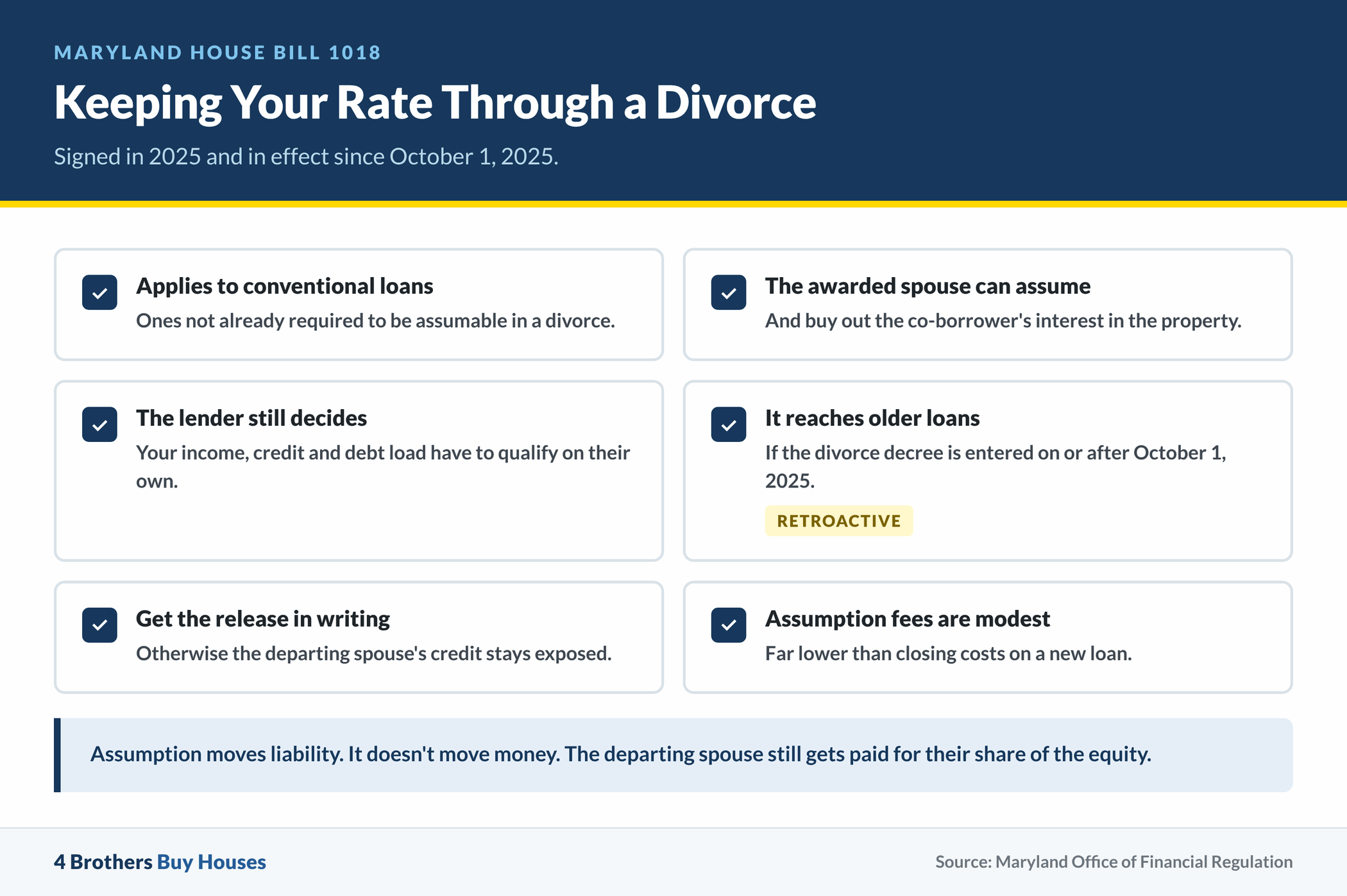
House Bill 1018 took effect October 1, 2025, after Governor Wes Moore signed it. It lets a spouse awarded the house in a divorce assume certain conventional loans and buy out the co-borrower’s interest. The Office of the Commissioner of Financial Regulation published an advisory explaining it.
Your lender still decides whether you qualify on your own income, credit and debt. The law also reaches back, so a loan from 2020 can qualify if the divorce decree comes after October 2025. Keeping a 3.1% rate can save a settlement that a refinance would have killed.
Not every loan is covered. The rule applies to conventional loans that weren’t already assumable after a divorce under state or federal law, and government-backed loans follow their own rules. Your servicer and attorney can tell you where your note falls.
Can I Remove My Spouse From the Mortgage Without Refinancing?
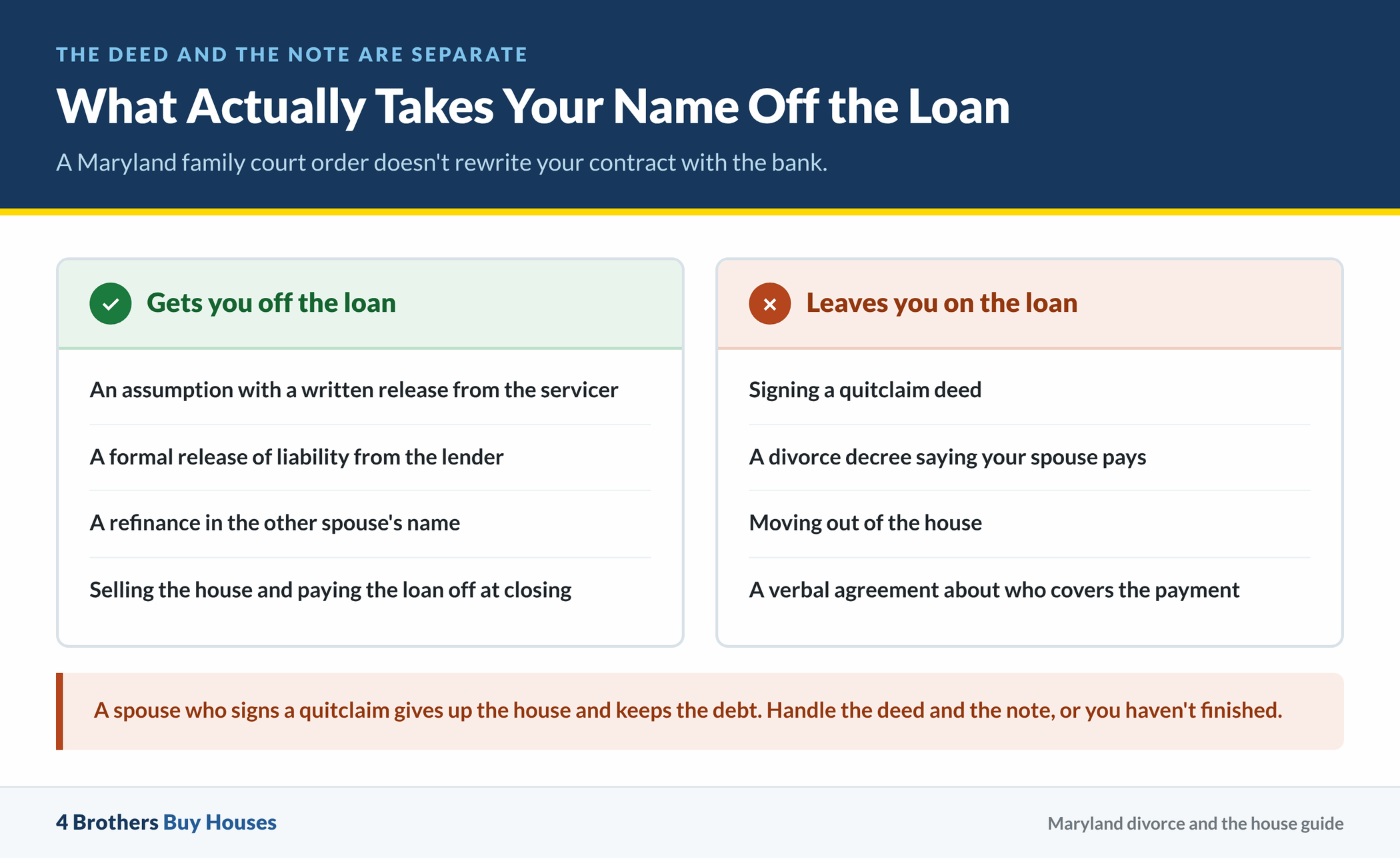
Yes, in some cases. An assumption under the new law, or a formal release of liability from the lender, can take a spouse off the loan. Get that release in writing, because an assumption without one leaves the departing spouse’s credit exposed.
A quitclaim deed doesn’t do it. It gives up the house and keeps the debt, which is the worst of both worlds. I’ve seen that mistake trip up people trying to buy a place of their own after a divorce.
Refinancing is the fallback, and a cash-out refinance can fund the buyout in the same transaction. Selling is the one path that’s certain, because the loan gets paid off at closing.
Does Assuming the Mortgage Buy Out My Spouse’s Equity?
No. Assumption moves the debt, not the money. The departing spouse still gets paid for their share, from savings, family help, retirement funds split through a qualified order or a trade of other assets.
Equity is market value minus every lien. Subtract the cost of a future sale too, typically seven to nine percent in Maryland. A licensed appraisal is the usual tiebreaker when you can’t agree on value.
Ask a title attorney about transfer and recordation taxes before closing. Maryland has exemptions that can apply to transfers between spouses as part of the divorce process, depending on how the transfer is structured.
Why Does Reaching an Agreement Matter So Much?
A contested property fight adds hearings, discovery and two attorneys billing by the hour. Settling the house early shortens the whole Maryland divorce process and leaves you in control.
Maryland has three no-fault grounds for absolute divorce, as the Maryland People’s Law Library explains: six-month separation, irreconcilable differences and mutual consent. Mutual consent rewards cooperation most, since a signed settlement covering property, alimony, custody and support removes the waiting.
If your grounds arose in Maryland, you need to live here when you file. If they arose elsewhere, one spouse needs six months of residency first. A divorce complaint goes to the circuit court where either of you lives, whether that’s Rockville, Upper Marlboro, Towson or Elkton.
What Does a Maryland Divorce Roadmap Look Like?
Start with an inventory of every account, vehicle and debt, plus the house. Most fights I see start with missing information rather than bad faith, so get current balances on paper before anyone argues about value.
Then value the property. An appraisal carries the most weight, an agent’s market analysis is free, and a cash offer shows what it’s worth as-is today. Running all three makes sense when the house is the largest asset in your divorce.
Next, decide the house question and put a date on it. Draft the agreement with counsel and file. Under mutual consent, a court can grant the divorce without a waiting period once the agreement covers everything and neither of you withdraws it.
Write down the boring details too. Who pays utilities while it’s listed? Who accepts an offer, and what happens if it sits past 60 days?
When Is Selling the House the Cleanest Option?
If neither of you can qualify alone, the decision makes itself. A buyout means carrying the full mortgage on one income plus covering the other spouse’s share. Deferred maintenance pushes the same direction, since a listing in Towson or Dundalk may need paint, carpet or inspection repairs that two people no longer coordinate well. A cash sale during divorce skips the repair conversation and gives you one date and one number.
Frequently Asked Questions
Can you sell the house before the divorce is final in Maryland?
Yes. If both of you are on the title, you can sell any time, as long as both sign. Many couples sell first and divide the proceeds through the settlement.
What happens to the mortgage if one spouse moves out?
Nothing changes with the lender. Both borrowers stay liable until the loan is paid off, assumed or released, whatever the divorce papers say.
Do we need separate attorneys to use mutual consent?
Maryland doesn’t require it, but one attorney can’t represent both of you. Having your own divorce lawyer review the agreement protects it.
How fast can a cash sale close in Baltimore?
Often within two to three weeks, with no lender, appraisal or repair talks. You can also push the date out to line up with a hearing.
Is the house considered marital property if only one name is on the deed?
Possibly. Courts look at when it was bought and what marital money went into it, so have an attorney review your history before you sign a divorce settlement.
If you’re weighing a buyout against a sale, we can give you a no-obligation cash offer so you know what that option looks like on paper. Take it to your attorney and decide when you’re ready.
Where We Buy Houses During a Maryland Divorce
Couples in the middle of a divorce call us from across the state when they want one closing and two checks. We buy homes in Bowie, Columbia and Glen Burnie. The 4 Brothers Buy Houses team buys throughout our Maryland service area.
A listing takes time you may not have. Redfin counted 5,467 Maryland home sales in August 2026, and the typical house spent 43 days on the market before it went under contract.
Get a Cash Number to Take to Your Attorney
If you’re weighing a buyout against a sale during your divorce, contact us and we’ll put an as-is offer in writing. You can read how our process works so both of you know the steps. Fill out the form below whenever you’re ready.
Helpful Maryland Blog Articles
- How Does Selling A House with A Mortgage Work in Maryland
- Selling a House That Needs Repairs in Maryland
- Selling a Home with a Reverse Mortgage in Maryland
- Do I Have to Sell My Home as Part of a Divorce in Maryland?
- Do I Need a Termite Bond to Sell My House in Maryland
- Maryland Earnest Money Rules for Real Estate Buyers
- Difference Between a Title and a Deed
- Should I Remodel My Kitchen Before Selling