

Rain hits Maryland hard in late summer. One storm puts four inches in a Rosedale basement, and by the end of the week the baseboards have gone dark and soft. Now the owner has two problems: a house with water damage, and a nagging question about whether anyone will touch it.
Buyers show up for a house with water damage anyway. Water-damaged homes change hands in Maryland every week, in every county, and a good share sell exactly as they sit. What shifts is the price, the pool of buyers willing to make an offer and the paperwork you sign on the way out.
I’ve been buying houses around Baltimore and the surrounding counties for years, and water in the basement is the most common condition issue I see. Here’s what the damage really costs, what the law requires you to say, and when paying a contractor stops making sense.
How Much Does Water Damage Lower Your Maryland Home’s Value?
A split-level in Parkville had a clean appraisal in the spring. By midsummer, a washer supply line had let go behind the wall and leaked for six days before anyone noticed. Two buyers walked, and the third wanted a serious discount for the water damage.
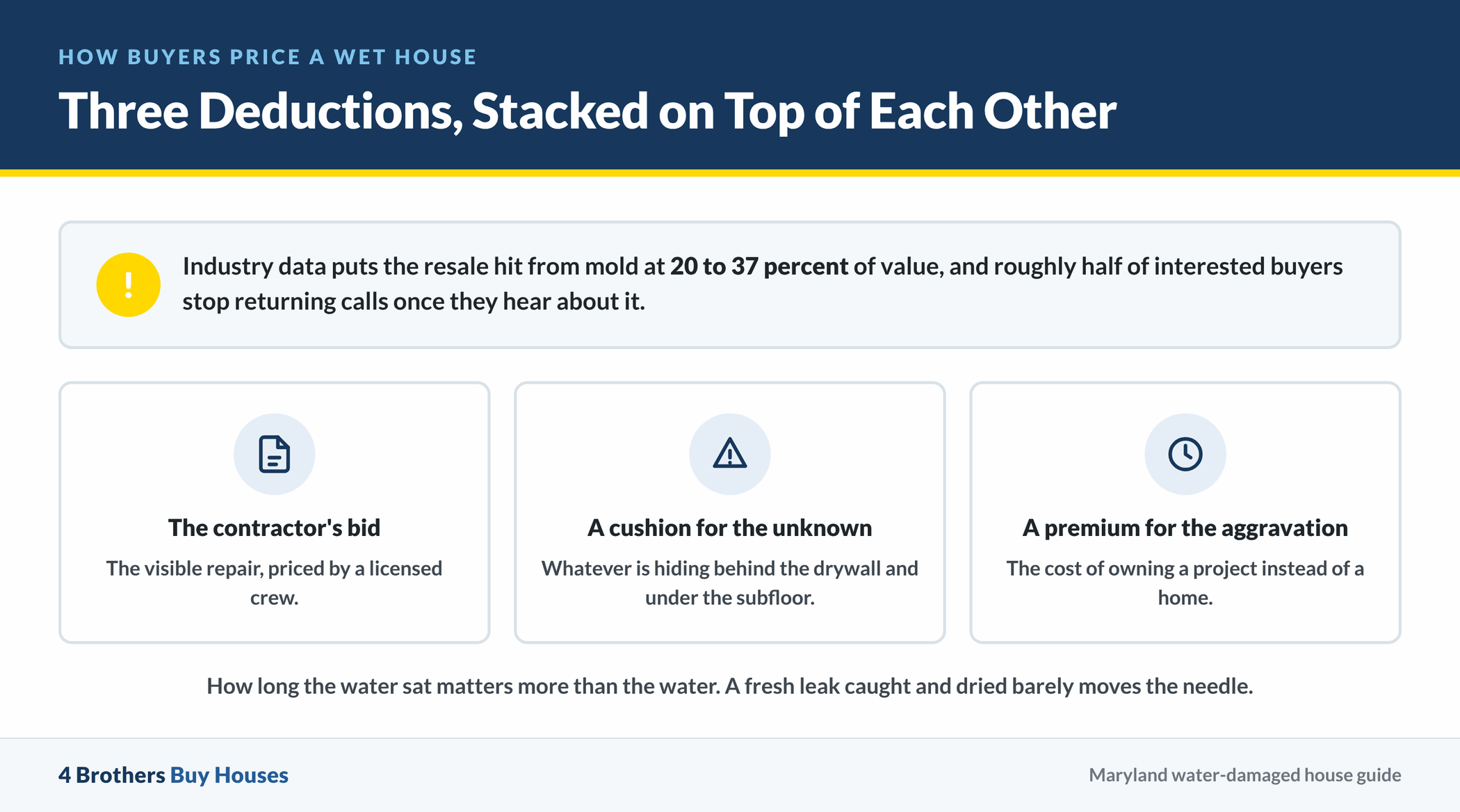
That discount is rarely the same as the water damage repair estimate, and this is where sellers get tripped up. Buyers subtract the contractor’s bid, plus a cushion for whatever’s behind the drywall, plus a premium for the hassle of owning a project.
The statewide market gives you a baseline. Maryland’s median sale price sat at $428,768 in September 2026, with half of all homes going under contract within 45 days, according to Redfin’s state tracking. A house with active water damage doesn’t follow those averages. It sits longer, gets fewer showings and draws a different kind of buyer.
Mold is the multiplier on water damage. Industry data puts the resale hit from mold between 20 and 37 percent of value, and roughly half of interested buyers stop returning calls once they hear about it. At that point you aren’t negotiating with the market. You’re negotiating with whoever’s left.
Lenders add their own pressure on a house with water damage. An appraiser who spots staining, buckled flooring or a musty crawl space will note it, and conventional financing can get conditioned on repairs before settlement. A buyer who loves your house still can’t close, and you either fund the fix or watch the contract die.
Location changes the size of the water damage discount more than Maryland sellers expect. In Baltimore City rowhouses, where party walls and below-grade kitchens make moisture almost a feature, buyers price it in without flinching much. In Howard or Anne Arundel, where the comparable sales are dry colonials with finished basements, the same stain reads as a red flag.
Want a rough read on the damage before anyone else walks the house? Start at the floor. Press a thumb into the baseboard where it meets the slab, since soft or crumbling means water sat there more than once. Look for white bloom on block walls, rust rings under the water heater and cupped edges on laminate. Then stand in the basement with the door closed and breathe. That smell is the first thing a buyer notices in the house, and no air freshener has ever fooled anybody.
My honest read is that the dollar value depends less on the water and more on how long it sat. A fresh leak, caught and dried, barely moves the needle. Six months of wicking into subfloor and joists is a structural conversation.
What Legal Rules Apply When Selling a Water-damaged Home in Maryland?
“Do I have to say anything if I already had the water damage fixed?” I hear that one constantly, usually in a lowered voice.
Maryland gives sellers of one-to-four-unit homes a choice between two forms, and you pick one. The Residential Property Disclosure Statement asks about the structure, systems and water and sewer. The Residential Property Disclaimer Statement sells the place as-is with no promises about condition. Both come from the State Real Estate Commission.
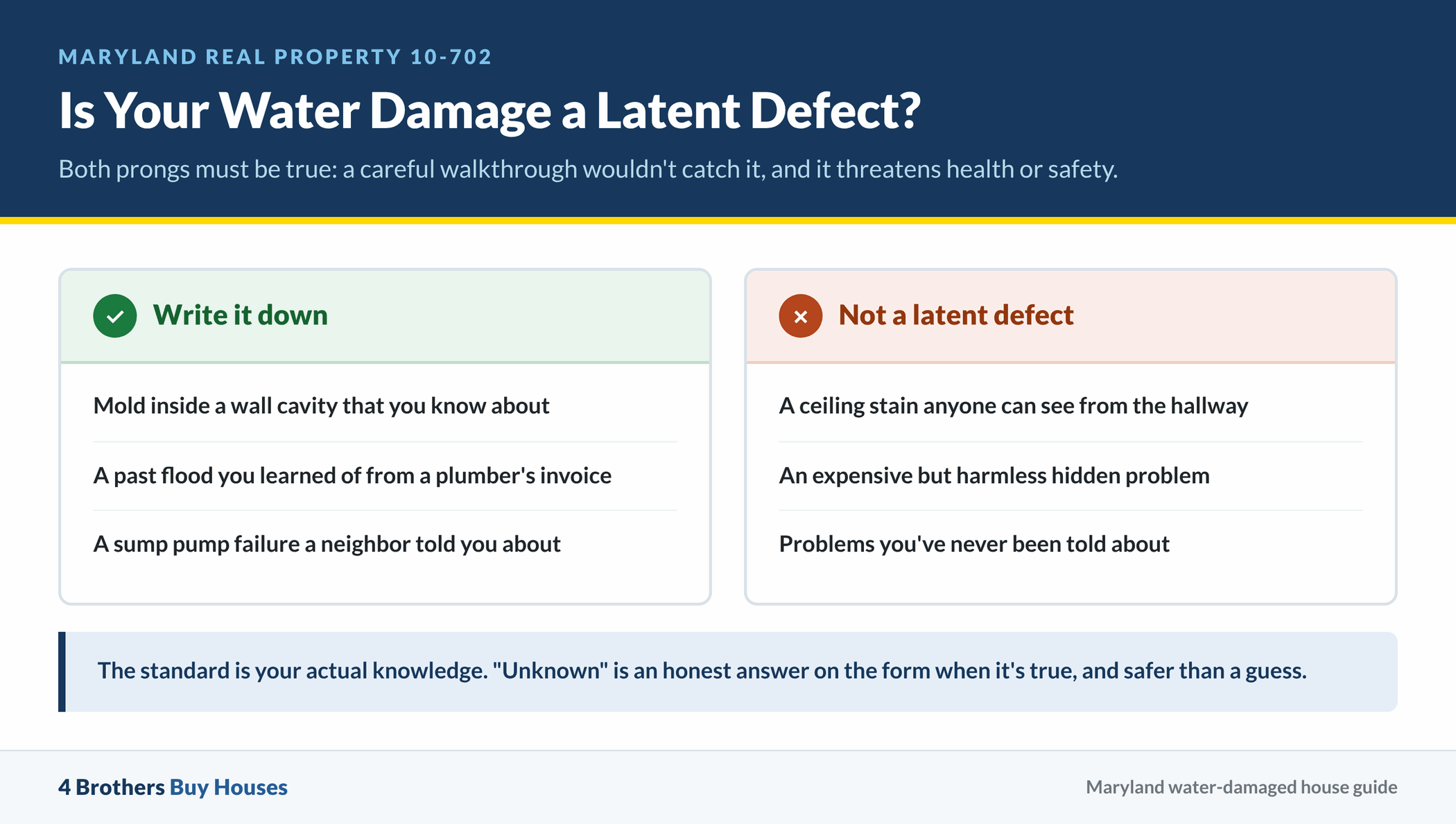
The disclaimer is where sellers get overconfident. Checking that box doesn’t erase your duty to disclose latent defects you actually know about. Under Maryland Real Property § 10-702, a latent defect has to clear two bars. A buyer wouldn’t reasonably catch it on a careful walkthrough, and it directly threatens someone’s health or safety.
Both halves have to be true. Visible water damage, like a ceiling stain anybody can see, isn’t latent. An expensive but harmless hidden problem fails the second test. Mold you know is growing inside a wall cavity lines up with both, and that’s the kind of thing you write down.
For hidden damage, the standard is your actual knowledge. You don’t have to hire an inspector before filling out the form or go looking for problems nobody told you about. What you can’t do is know and stay quiet.
Maryland heirs ask about hidden damage all the time, since they’re selling a house they never lived in. If your aunt’s basement flooded in 2009 and nobody mentioned it, you don’t know, and “unknown” is an honest answer. What trips up executors is the middle ground: the plumber’s invoice in a kitchen drawer, the stack of dehumidifiers in the garage, the neighbor who mentions the sump pump failing. Once you’ve learned it, you know it.
Timing matters too. The form goes to the buyer at or before contract signing. A buyer who gets it late can back out and recover the deposit within a short window, and your title company or closing attorney can confirm the exact days.
From the buying side, my advice is to keep every record of the water damage. Plumber invoices, the adjuster’s scope, the dehumidifier rental receipt and photos of the wall opened up all help. I’d rather get a thick folder of ugly history than a clean form and a mystery, and so would most serious buyers. Written disclosure also heads off arguments later, because the record shows what you said and when you said it.
If the house has tenants, Maryland’s separate landlord rules on habitability and mold apply on their own track, whether or not you’re selling.
Should You Sell Your Maryland Home As-is or Fix It First?
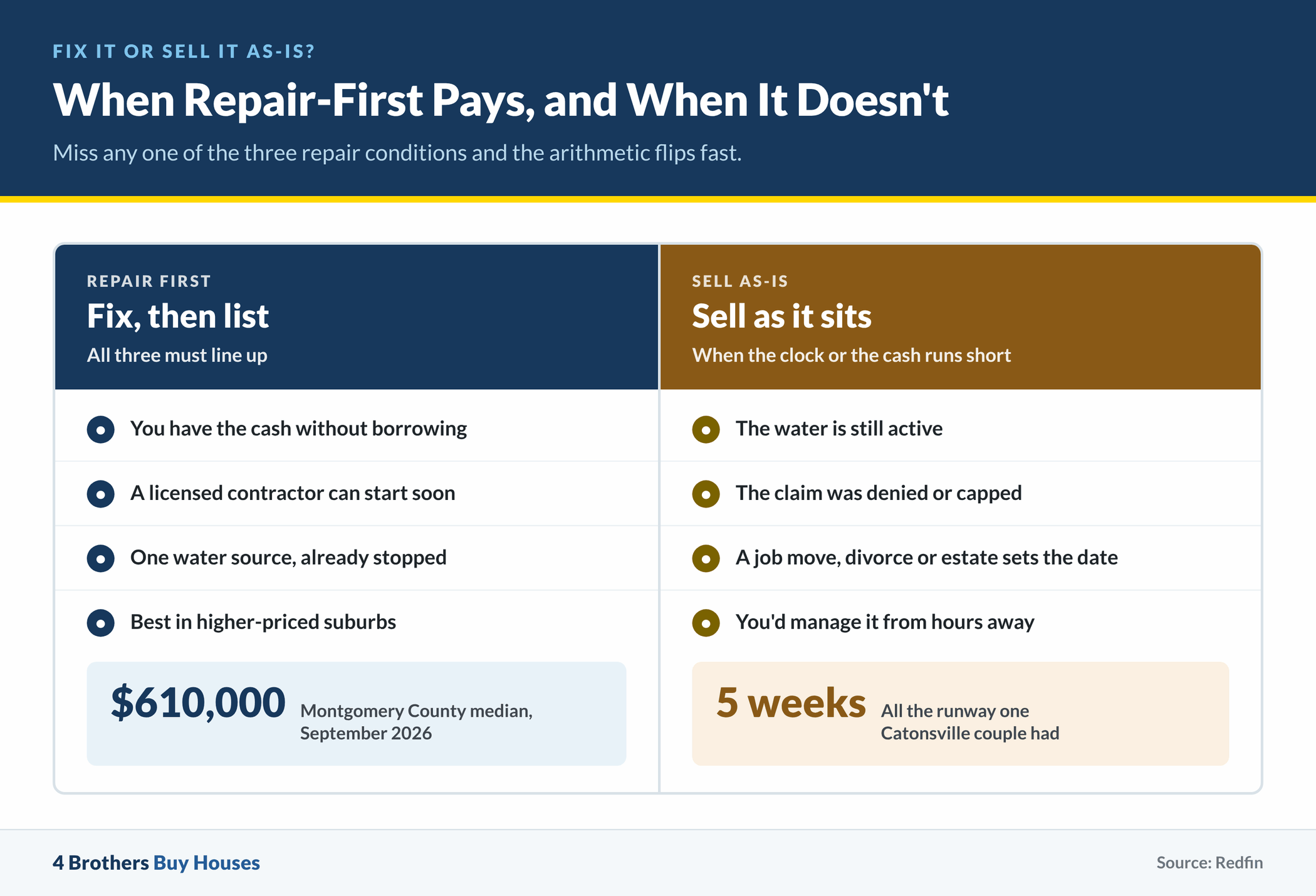
Five weeks. That’s all the runway a young couple in Catonsville had after his employer moved him south early last year, and their basement had flooded twice in eighteen months. The laundry room smelled like a wet tent, and the garage was stacked with boxes they’d never unpacked. We bought the house, water damage and all, on a Friday so they could drive out that weekend.
If you’re not on that kind of clock, repair-first deserves a real look. It works when three things line up. You have the cash without borrowing, you can get a licensed contractor scheduled soon, and the damage has one source that’s already been stopped. Hit all three, and a repaired house usually nets more than an as-is sale, even after paying for the work.
Miss one and the math flips fast. Mortgage, taxes, utilities and insurance keep running every month the house sits half-demolished. Water damage jobs almost never finish on the first estimate, because opening a wall reveals what it was hiding.
Get more than one bid on the damage, and make them comparable. Ask each contractor to name the water source in writing, list what’s coming out versus being dried in place, and say what happens to the price if the subfloor or joists are compromised. A bid that doesn’t mention the source is cosmetic, and cosmetic work on a house with water damage buys you a repeat performance. Get start and finish dates on paper, then assume the finish slips.
Inventory matters here too. Maryland’s supply of homes climbed 21.3 percent year over year to 18,748, with new listings nearly flat, per Bright MLS data reported in late October 2026. A repaired house has to compete with dry, move-in-ready listings on price, not just condition.
Repair-first pays off best in Maryland’s pricier suburbs. Montgomery County’s median hit $610,000 in September 2026, with homes selling in about 47 days. At that price, a fifteen-thousand-dollar remediation can pay for itself several times over, because the buyers are financed, picky and paying for a turnkey house.
Common advice says fix the cosmetic stuff and disclose the rest. I disagree when moisture is still active. Painting over a stain on a wall that’s still wet turns a condition problem into a credibility problem, and I’ve watched an inspector with a moisture meter find it in four minutes. Stop the water and document the fix, or sell the house honestly as it is.
Sellers who choose as-is often do it for reasons that have nothing to do with money: an out-of-state job, an aging parent, a house they inherited three hours away. Companies like 4 Brothers Buy Houses exist for exactly that, and in my experience the goal is a clean exit, not the last dollar.
How Do You Prepare a Maryland Home with Mold for Sale?
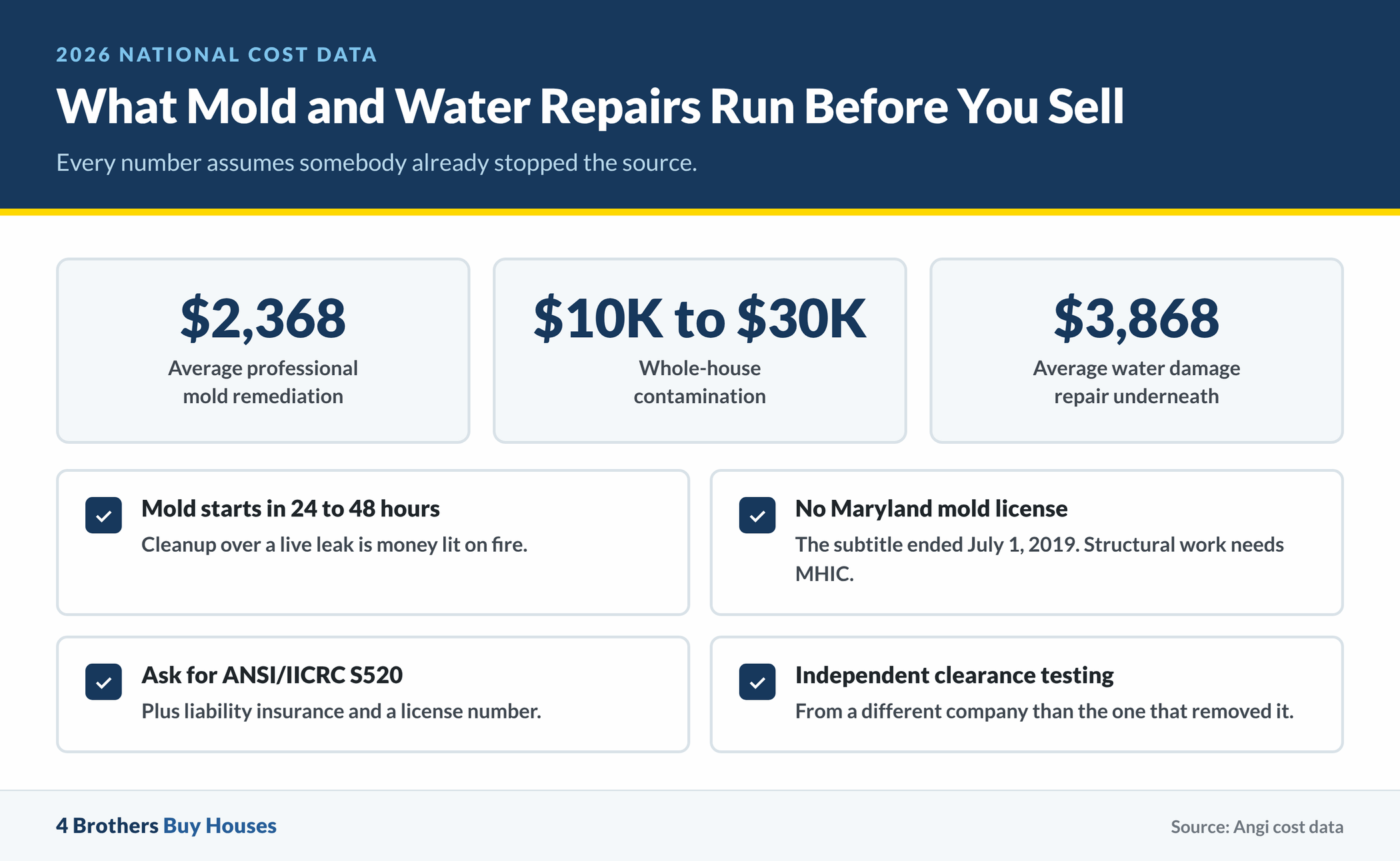
The 2026 national average for professional mold remediation landed around $2,368, with most jobs between $1,200 and $3,750, based on Angi’s cost data. Whole-house contamination runs $10,000 to $30,000 and sometimes more. The water damage repairs underneath average $3,868 nationally, typically between $1,383 and $6,369.
Those numbers assume somebody already stopped the water at its source. If the leak is live, every dollar spent on cleanup is wasted, since the EPA notes mold can start forming within 24 to 48 hours of a water event.
Vetting a remediation company in Maryland takes homework, because Maryland doesn’t run an active standalone mold license. The Maryland Mold Remediation Services Act passed in 2008, but the MHIC’s own licensing FAQ notes the subtitle terminated on July 1, 2019. A contractor doing structural water damage work, like replacing drywall, flooring or framing, still needs an MHIC home improvement license.
Voluntary credentials and insurance fill the gap. Reputable firms follow the ANSI/IICRC S520 standard for containment, moisture control and cleaning, and they’ll say so without being asked. Get the liability certificate and license number before any demolition starts.
Expect plastic sheeting taped floor to ceiling, a machine keeping the work zone under negative pressure, and crews in respirators hauling out bagged material. Wet drywall usually comes out a couple of feet above the highest moisture line, insulation gets tossed, and sound framing gets cleaned and dried. Most of the house stays usable, though the noise is constant and the containment has to stay sealed until clearance comes back, so plan around it.
Independent clearance testing is the step sellers skip and later regret. Have a separate company, not the one that did the removal, run the test. That gives a skeptical buyer a document that means something.
Before a single showing of the house, I’d put four things in the file: the invoice naming the water source, the remediation scope, clearance results and dated before-and-after photos. That package shortens negotiations more than staging ever will, because it replaces a buyer’s imagination with evidence.
None of this guarantees a full-price offer. Some buyers hear “mold” and leave the house no matter what. Good documentation keeps the ones who stay from assuming the worst.
Cheap fixes still send a signal to Maryland buyers. Downspout extensions, a regraded flower bed and a dehumidifier running during showings won’t fix structural damage, but they show somebody’s been paying attention.
What Are the Best Ways to Sell a Moldy Home in Maryland?
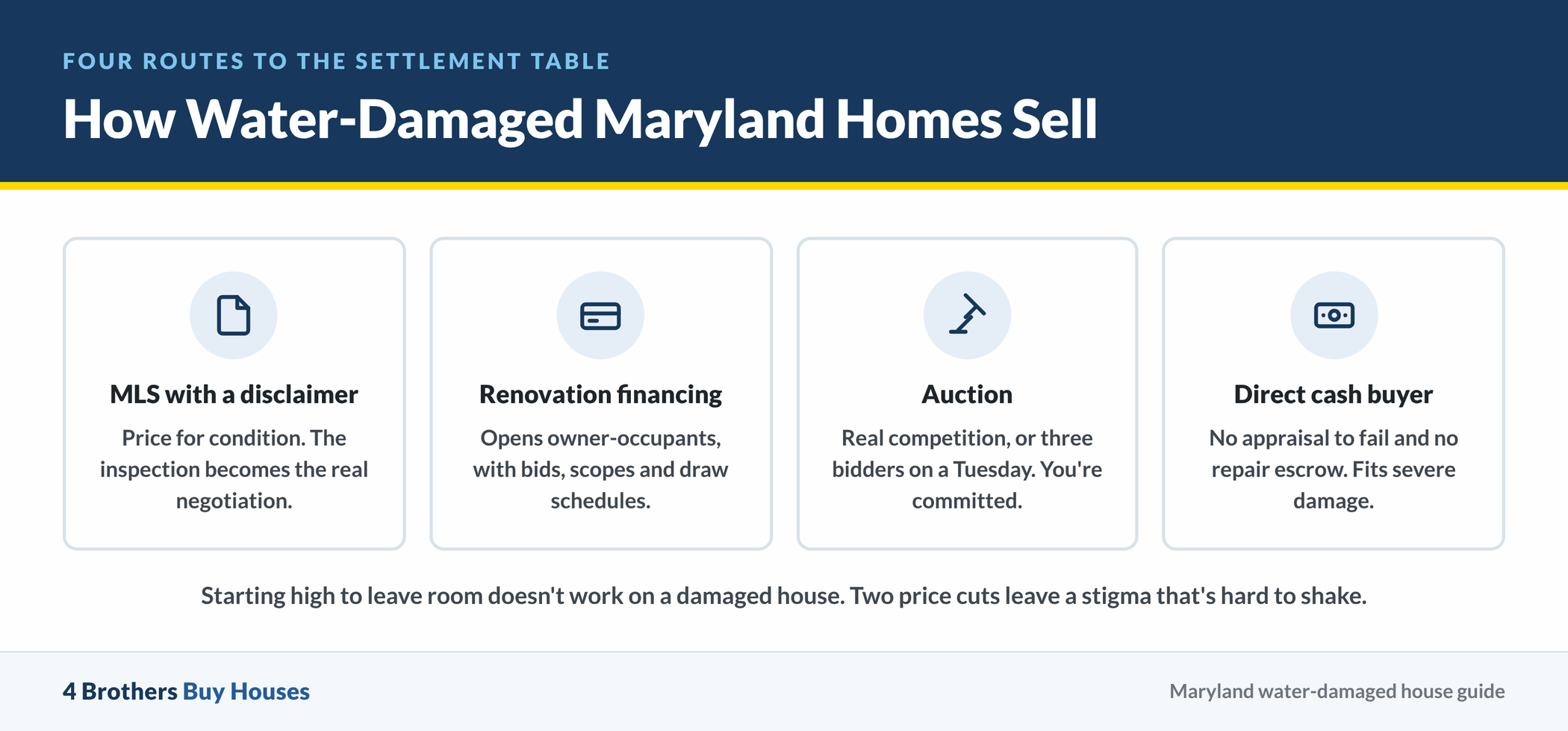
There are four routes worth knowing for a house with water damage.
Route one is listing with a realtor on the MLS, using the disclaimer. You price for condition and wait for a buyer with cash or a renovation loan. Baltimore’s median sale price ran about $230,000 for the three months ending September 2026, with homes averaging 48 days on market. Add water damage, a bad roof or a cracked foundation, and that can stretch past ninety days before a contract survives inspection.
On that route, the inspection is the real negotiation. As-is means you won’t promise repairs. It doesn’t stop the buyer from inspecting and walking. Sellers who’ve documented the water damage history tend to hold their price, while those who haven’t usually give something back. Moisture also draws termites, so an inspector who finds water damage often looks hard for termite damage nearby.
Route two is renovation financing, and it’s underused. Rehab loans let buyers roll damage repair costs into the mortgage, which opens your house to owner-occupants. The tradeoff is process, since contractor bids, approved scopes and draw schedules mean a longer path to closing.
Auction is route three. Baltimore has a deep auction culture, and a well-marketed auction can create real competition. It can also produce a disappointing number on a Tuesday morning when three bidders show up instead of twelve, and you’re committed either way.
Selling direct to a local cash buyer is route four, and it fits severe damage best. There’s no lender appraisal to fail, no inspection contingency to renegotiate and no repair escrow. 4 Brothers Buy Houses buys across Baltimore, the surrounding counties and the DC suburbs, pricing the house against what it costs to fix the damage rather than what it’d be worth dry.
Where in Maryland you sell changes which route wins. On the Eastern Shore, September 2026 brought a median sold price of $360,000 and an average of 61 days on market, so an as-is listing can sit a whole season. In Baltimore County, move-in-ready single-family homes sold at a median of 13 days and above asking.
Pricing the house is where most as-is sellers go wrong. Starting high to leave room doesn’t work, because buyers for a house with water damage run their own math. A house that goes stale after two price cuts carries a stigma that’s hard to shake.
How Do You Know It’s Time for a Cash Sale on Your Water-damaged Home?
When the water damage repair bid outruns your equity, the house is telling you what kind of sale it wants. Arguing with it costs money every month.
A few signals point the same way. Your insurance claim was denied or capped well under the damage, which is common since most homeowners insurance policies exclude gradual leaks and groundwater. Only flood insurance covers rising water, and if the house sits in a flood zone, the buyer’s lender will usually require it. You don’t have cash for repairs and don’t want to borrow against a house you’re leaving. Or the house is vacant and you’re paying to heat it so the pipes don’t freeze.
Deadlines count too. Divorce decrees, estates, relocations and tenant turnover all come with dates, and a listing can’t promise one. A cash buyer can, because no underwriter sits in the chain.
Before you call anybody, gather three things. Get whatever paperwork exists on the damage, including any claim denial letter. Get a current payoff plus any liens, unpaid taxes or water bills, so you know your net before hearing an offer. And confirm who has authority to sign for the house, which matters most with inherited houses and divorces.
A fair cash offer comes in writing, with a closing date, no financing contingency and clear terms on who pays what. Skip any buyer who won’t commit on paper or keeps renegotiating the damage after inspection. Get two or three offers, compare net proceeds, and ask whether each buyer is closing or assigning the contract.
The walkthrough is short and unglamorous. A buyer who does this regularly looks at the mechanicals, foundation, roof and the water damage, not your clutter. You don’t need to stage anything or empty the basement, and pointing out the damage tends to speed things up.
One pattern keeps showing up. Sellers spend a season trying to fix a house with money they don’t have, then sell for less than the offer they turned down in spring. Waiting on water damage is a decision with a price tag.
An owner in Dundalk was splitting assets in a divorce and wanted one less thing to fight about. An upstairs tub had overflowed and brought down part of the kitchen ceiling, and neither spouse wanted to manage a water damage contractor from two addresses. We walked it on a Tuesday and wrote the offer that afternoon, then let the attorneys sort out the proceeds at settlement.
Frequently Asked Questions
What’s the Most Common Reason a House Fails to Sell?
Price that doesn’t match condition, nearly every time. A house with water damage listed at dry-house pricing gets showings and no offers. The next most common reason is a seller who won’t disclose damage history up front, which kills sales at inspection.
Is There a Best Week of the Year to Put a Maryland House on the Market?
Late spring usually brings the most buyer traffic in Maryland. For a water-damaged house, though, condition and price matter far more than season, and distressed-property buyers shop year-round.
How Much Value Does Water Damage Knock Off a House?
It depends on whether the source was stopped and how long the water sat. One documented, fixed leak might mean a modest adjustment. Widespread mold damage can cut a meaningful share of value and scare off many buyers.
What Closing Costs Does a Buyer Pay in Maryland?
Buyers usually pay lender fees, appraisal, title exam and insurance, recording charges and their share of transfer and recordation taxes, which vary by county. Some counties offer reductions for first-time buyers. Your title company can give exact figures once you have a contract.
If you’ve got a house with water damage and aren’t sure which way to go, I’m happy to walk through the numbers with you, including when fixing it beats selling. The team at 4 Brothers Buy Houses looks at houses all over Maryland in any condition. No pressure, and no hard feelings if you list it instead.
Water-Damaged Houses We Buy in Maryland
Basement water damage is the most common condition we see. We buy houses in Dundalk, Catonsville and Baltimore as they sit. The 4 Brothers Buy Houses team buys across our Maryland service area.
A dry house gets the showings first. Redfin counted 5,467 Maryland home sales in August 2026, and the typical house spent 43 days on the market before it went under contract.
Compare a Cash Number to Your Repair Bid
Got a contractor estimate on the water damage? Contact us and set an as-is offer beside it. You can read how our process works before you call. Fill out the form below to get started.
Helpful Maryland Blog Articles
- Selling Partial Ownership Of A House In Maryland
- Tenant Damage vs. Normal Wear And Tear In Maryland Rental Properties
- Who Pays For Appraisal And Inspection In Maryland
- How To Successfully Sell Your House At Auction In Maryland
- Can An Executor Sell Property In Maryland
- Can A Seller Legally Back Out Of A Real Estate Contract In Maryland?
- Selling Your Maryland Home With An Incarcerated Spouse
- Can You Sell a House With Water Damage in Maryland
- How to Sell a House in Foreclosure in Maryland
- Selling a house in probate in Maryland
- How to Sell an Inherited House in Maryland
- Selling A House With Unpermitted Work In Maryland
- When Is the Best Time to Sell a House in Maryland