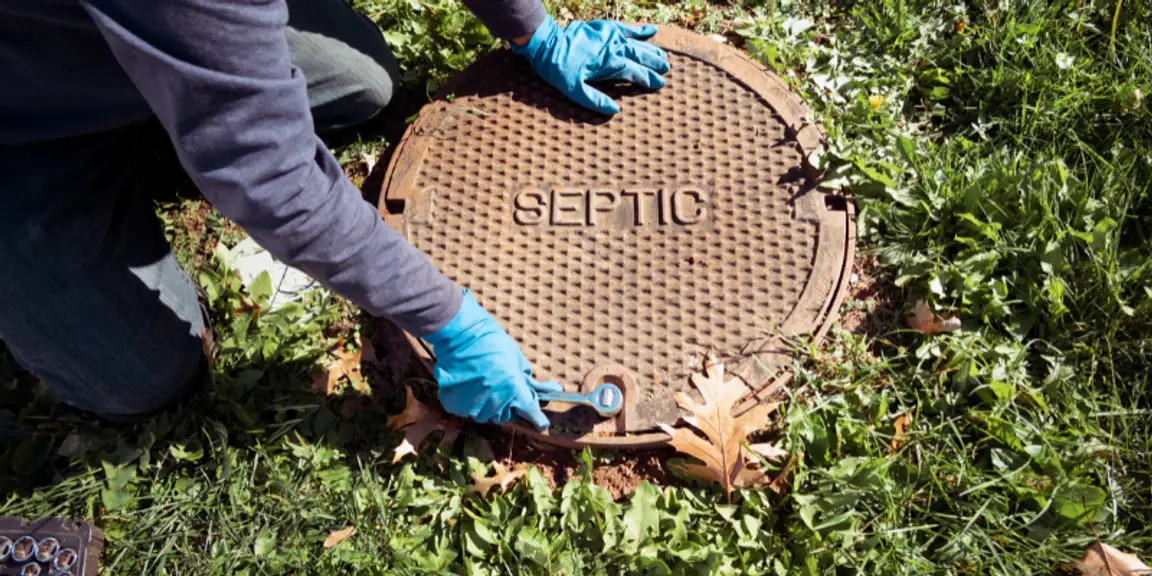

Roughly 420,000 Maryland homes send their wastewater into the ground instead of a sewer main, and Frederick County holds a sizable share of them. Out past Urbana, up toward Thurmont, along the farm lanes near Jefferson, septic is simply how things work. Until it doesn’t. When a system quits, the panic that follows usually has less to do with sewage than with money, and with the fear that the house just became unsellable. It didn’t.
A house with a failing septic tank still sells in Frederick. What changes is who can buy it, how they’ll pay for it and how much of the repair comes off your price.
What Is a Septic System and How Does It Work?

So picture what’s buried under your side yard. Wastewater leaves the house through one pipe and lands in a septic tank. On an older Frederick property that’s most often a 1,000 gallon concrete box, the kind I’ve popped the lid on more than once. Solids sink. Grease floats. Called effluent, the liquid in the middle drifts out to a drain field of perforated pipe laid in gravel trenches.
Soil does the real work from there. Bacteria in the ground break down what’s left before it reaches groundwater, which is why the county runs a percolation test before anyone builds a house. A perc test measures how fast water moves through your dirt, and that rate decides what kind of system your lot can legally hold.
The Frederick County Health Department’s Well & Septic office recommends pumping a residential tank every three to five years. That’s the whole maintenance program for most homeowners. Skip it long enough and solids migrate into the drain field, where they clog the gravel and end the system’s life early.
How Often Should a Frederick Septic Tank Be Pumped and Inspected?
Pumping and inspecting aren’t the same job. A pump-out empties the septic tank. An inspection tells you whether the baffles, the outlet pipe and the drain field are still doing their part.
The EPA’s septic care guidance says the average household system should be inspected at least every three years by a septic service professional. Alternative systems with pumps, float switches or other mechanical parts need a look more often, generally once a year. If your house has one of those units, a service contract keeps that schedule from slipping.
Keep every receipt. A buyer’s inspector will ask when the tank was last pumped, and a folder of dated records answers that before it turns into a price cut. Frederick buyers who see three or four pump-outs on paper tend to relax about the rest of the house.
How Do I Know My Septic System Is Failing?

Guess wrong about this and a $400 pump-out turns into a five-figure excavation. The early signs are small and polite. Toilets flush slower than they used to, and a drain gurgles when the washing machine empties. A sweet, sour smell lingers near the septic tank lid after a rainy week.
Then the obvious ones arrive: backups into the lowest bathroom in the house, standing water over the drain field, grass that’s suddenly greener in one rectangle. I’ve learned to spot that last one walking a yard. Well water testing high for nitrates or bacteria points the same direction. If the house sits empty, those signs can hide for months because nobody is running water.
A family in Jefferson called me not long ago after two agent listings expired back to back with zero offers. The inspection report from a sale that fell through was still sitting on their kitchen counter next to a stack of pump-out receipts. The Saturday I walked the property you could smell the problem from the barn. Buyers had toured the house, circled that drain field and walked away, a pattern I’ve watched play out on more Frederick septic sales than I can count.
Why Did My Septic System Fail in Frederick, MD?
Did you break it? Almost never. Frederick County’s geology does plenty of the damage on its own. We sit on Piedmont clay in places and limestone karst in others, and both make life hard on a drain field. Clay holds water instead of absorbing it. Karst can open channels that worry health inspectors far more than they worry homeowners.
Age is the other culprit. Septic systems installed in the 1960s and 70s around Walkersville and Middletown were sized for smaller families and far less laundry.
Before you blame anyone, pull the county’s septic file for the house. It shows what the field was designed to carry, and you can compare that with how the house gets used today.
Then there’s usage creep. A finished basement bathroom, a new dishwasher, two more people living in the house, and a drain field designed for a three-bedroom load starts running past capacity. Heavy spring rain along the Monocacy saturates the soil, and effluent has nowhere to go. Tree roots, a crushed distribution box, and a failed pump all show up regularly too. None of that is your fault. It’s construction that aged out.
What Does a Septic System Cost to Fix or Replace in Frederick, MD?

Plenty of sellers hear “septic problem” and mentally budget a few thousand dollars, the way you’d budget a water heater. The repair might land there. The replacement won’t, and if the house also needs a roof or a kitchen, the septic bill stacks on top of those. Across Maryland, drain field repairs commonly run from about $1,000 to $10,000, and a full system replacement generally falls between $10,000 and $35,000 depending on soil, slope, and access.
The drain field is the expensive half. A septic tank is a box; a field is engineering, excavation, and a permit.
Then add the costs nobody mentions up front. Permit fees through the Frederick County Health Department come first. Then there’s a new perc test if the original field can’t be reused, landscaping to repair the damage from heavy equipment, and the weeks of delay while the county schedules a site visit. That last part alone can stall a closing. Advanced treatment units cost more than conventional gravity systems.
My opinion, formed over a lot of these sales: replacing a system purely to sell is usually a bad trade. You rarely recover the full cost in price, and you’ve tied up cash for months on a house you’re leaving anyway.
Does Maryland Require a BAT Septic System When You Replace One?
BAT stands for best available technology, a septic unit that strips nitrogen out before effluent reaches the soil. Maryland’s rules for it sit in COMAR 26.04.02, and the state narrowed them in a change that took effect November 24, 2016.
Since then, the BAT requirement for new and replacement systems has centered on the Chesapeake Bay Critical Area, the land nearest tidal water. Outside it, new construction and replacement septic systems aren’t required to install BAT under the state rule. Frederick County sits well inland from tidal water, so most sellers here fall in that second group. Your lot’s own permit conditions still decide what goes in the ground behind your house.
Choosing BAT anyway can make sense, and the state helps pay for it. The Bay Restoration Fund puts grant money toward BAT upgrades, ranking failing systems in the Critical Area first and failing systems elsewhere next. Under recent MDE program guidance, a household earning $300,000 a year or less could receive up to 100 percent of eligible costs. Higher earners could receive up to 50 percent.
Grant money moves through local recipients, and the rules shift. Ask the Frederick County Health Department what’s open this year before a BAT bid shapes the price of your house.
Where Can I Find Septic Tank and Well Pros in Frederick, MD?
Start at 350 Montevue Lane. That’s the Frederick County Health Department’s Environmental Health office, and their sanitarians hold septic records going back to 1950. An Information Research Request Form gets you the size and location of your system, and the office asks for about ten business days to pull it. Knowing your septic tank’s size and the field’s footprint changes every conversation that follows.
Repairs require a permit, and the application is submitted in person. You’ll also need to name a licensed Frederick County septic installer before the county will move. Maryland licenses onsite wastewater professionals at the state level, so verify credentials before you sign anything.
From there, your installer calls the Health Department to set a site meeting with a sanitarian. That visit covers any soil evaluation or percolation testing the repair needs, and a backhoe has to be on hand for the digging. Once the new work is in place, the installer calls for a final inspection before anything gets covered. You then receive a certificate confirming the repair, and that page belongs in the folder you hand a buyer with the house.
Get three bids. Septic pricing in this county varies more than almost any other trade I work with, and the spread between the first and third bid is often thousands of dollars. Ask each Frederick installer whether the number includes the permit, the perc test and regrading the yard.
Frederick County also runs a pump-out rebate program for homeowners who use a licensed hauler, with amounts and funding posted on the county page.
How Do Lenders Treat a House with a Failing Septic System?
A buyer’s loan program decides how much a septic problem matters to the sale of your house. Cash doesn’t care. Financing does.
FHA appraisers have to look over the septic system for signs of failure or surface evidence of malfunction, under HUD’s single-family handbook. Readily observable problems lead to a required repair or a further inspection before the loan closes. Where the local health authority requires a report on the septic system, the lender has to get one.
VA loans follow the same general logic. A VA appraiser checks the house against the VA’s minimum property requirements, which include safe sewage disposal, and flagged items usually have to be fixed before settlement.
Conventional lenders lean on the appraisal and the inspection as well. When a repair can’t finish before settlement, some lenders allow an escrow holdback, where money is set aside at closing and released after the work passes. Terms vary by lender and loan program. Don’t count on one until the buyer’s loan officer confirms it in writing.
Wet or frozen ground can push a Frederick repair past a closing date. That’s when a holdback, or a buyer paying cash for the house, keeps the sale alive.
What Are My Options for Selling a House with a Bad Septic System?
“No lender will touch it, so I’m stuck.” That’s the objection I hear most, and it’s half true. FHA and most conventional mortgage underwriters want a functioning system at closing, which does shrink your buyer pool. It doesn’t eliminate it.
You’ve got three realistic paths, starting with fixing the issue first and then listing the house at full retail. Disclose the failure and list as-is at a discount, accepting that financed buyers will mostly pass. Or sell to a cash buyer or investor who prices the repair into the offer and closes without a lender in the room.
Right now, you get some breathing room in Frederick’s market. In the thirty days ending in early October 2026, 173 homes closed in Frederick at a median sold price of $465,000. The median time on market was 21 days, according to Bright MLS data compiled by local brokerages. Healthy numbers, but those are working systems and clean inspections.
Fixing first makes sense when the house is otherwise in great shape and you aren’t in a hurry. A cash sale fits better when the house is vacant, inherited or tied to a deadline. Listing as-is lands somewhere between.
Which path fits depends on whether you have the cash and the patience. If you don’t have either, as-is is arithmetic, not surrender, and companies like 4 Brothers Buy Houses buy a Frederick house in exactly this condition.
How Do I Talk to Buyers About Septic Problems in Frederick, MD?
Say it upfront. First conversation about the house, in writing, before anyone pays for an inspection. Maryland disclosure law expects material defects to come out, and a hidden septic failure surfaces during due diligence anyway. Burying it just means losing the buyer in week three instead of week one.
Sellers here pick between two paths on the state’s Residential Property Disclosure and Disclaimer Statement. You either disclose known defects or disclaim and sell the house as-is. The disclosure side asks about the condition of the water and sewer systems. A disclaimer doesn’t erase every duty, though. You still have to reveal known latent defects, the kind a careful visual inspection wouldn’t catch and that threaten health or safety.
Bring documents to the table. Pump-out records, the county’s file on your system, contractor estimates, any BRF grant correspondence. A seller holding three bids negotiates from a real number. Guessing gets you hammered on price.
Frederick buyers notice everything once a septic issue shows up on paper. Sellers in Frederick averaged $8,800 in concessions in recent quarters, and a known septic defect tends to push that number up fast. Better to name the discount yourself than to let a buyer’s agent invent one after the inspection report lands.
One more thing. Don’t promise a repair timeline you can’t control. Permits, soil evaluations, and contractor backlogs in this county move on their own schedule, and a missed closing date costs you more goodwill than the original disclosure ever would.
Frequently Asked Questions
Do I have to replace a failing septic system before selling in Frederick County?
No. Maryland does not require a seller to repair a failed system before transfer. What you do have to do is disclose it. The practical limit is financing: most lenders want a functioning system at closing, so an unrepaired system generally narrows the house to cash buyers.
How much does a new septic system cost in Frederick County, MD?
Conventional gravity systems typically run in the five-figure range, and engineered or BAT systems with pumps, mounds, or tight site conditions run considerably higher. Soil conditions, lot slope, and replacement area availability drive most of the spread, which is why three bids matter.
Will a septic inspection kill my sale?
Not automatically, and plenty of Frederick buyers will still want the house at the right price. A failed inspection changes the conversation to price and terms, not whether the house sells. Sales fall apart when the problem shows up as a surprise, not when it shows up early with estimates attached.
Can I get help paying for septic repairs in Maryland?
Possibly. The Bay Restoration Fund offers grants for eligible upgrades, particularly for failing systems in the Chesapeake Bay watershed, with priority rules and income considerations that change year to year. Check current terms with Frederick County Health Department before you budget around it.
How long does septic permitting take in Frederick County?
Plan for weeks, not days. Soil evaluation windows, percolation testing, plan review, and contractor scheduling all stack. Spring and fall tend to be busiest in Frederick County, and wet ground can delay testing entirely.
What does “as-is” actually mean for a septic sale?
It means you are not making repairs and the buyer accepts the house and its septic system in their current condition. You still disclose what you know. As-is limits your repair obligation, not your honesty obligation.
If you’re weighing a repair bill against a sale, it helps to see both numbers side by side before deciding anything. Get a contractor estimate, then find out what the house is worth to a cash buyer in its current condition. No obligation either way, and knowing the spread usually makes the decision obvious.
Where We Buy Septic Homes Around Frederick
Failed drain fields are a normal part of our work in Frederick County, and a soggy yard doesn’t stop us from buying a house. We buy houses in Frederick, Germantown and Gaithersburg. The 4 Brothers Buy Houses team also buys across our Maryland service area.
Working systems and clean inspections set the pace statewide. Redfin counted 5,467 Maryland home sales in August 2026, and the typical house spent 43 days on the market before it went under contract.
Weigh Your Septic Bid Against a Cash Number
Once you have a contractor’s estimate, contact us and we’ll price the house with the septic as it is. You can read how our process works before you decide. Use the form below to send the address.
Helpful Frederick Blog Articles