

You don’t have to empty a furnished house before you hand over the keys. The furniture, the appliances, the patio set and that treadmill in the basement can all stay, as long as the paperwork says so. Maryland sellers rarely get stuck on permission. They get stuck on how the contract treats a sale with the furniture inside, and on whether a mortgage lender is part of the buyer’s side.
Can You Sell a House with Furniture in Maryland As-is?
Yes. A furnished house can sell as-is, with no repairs and no cleanout first. Redfin’s statewide numbers show the typical Maryland home sold for $428,768 in September 2026 and went under contract in 45 days. Those figures describe the market for houses in decent shape. An as-is sale of a furnished house plays by other rules. The price reflects the property as it stands today, and you won’t fix the roof, the HVAC system or the plumbing before settlement.
Selling as-is with the furniture inside doesn’t mean you stay quiet, though. Maryland law still gives you a disclosure duty.
Section 10-702 of the Real Property Article covers sellers of single-family residential property. You give the buyer either a disclosure statement or a disclaimer statement. It has to reach them on or before the day you both sign the contract. If you pick the disclaimer, you’re making no representations about condition. You still can’t disclaim a latent defect you know about. The statute defines that narrowly: a problem a buyer couldn’t reasonably find on a careful visual inspection, and one that threatens someone’s health or safety.
A cracked driveway isn’t latent, then. Sewage backing up into a basement is another story. Known radon readings, a lead-based paint history in an older rowhome and a furnace leaking carbon monoxide all belong on the form. The Maryland Real Estate Commission posts the official disclosure and disclaimer form. I’ve read more of these than I can count, and it’s worth twenty minutes of your evening.
What Happens to the Furniture, Appliances, and Everything Else Left Inside?
Imagine a split-level with four bedrooms of furniture, a packed attic and heirs scattered between Maryland, Texas, and overseas. Six weeks later it’s sold, and nobody ever rented a dumpster.
A while back I bought a brick cape in Catonsville from two adult children. Their mother had lived there since the early nineties. Her husband’s woodworking bench was still in the garage, along with a chest freezer and roughly forty storage bins. On a Saturday morning they took the photo albums and a clock. Then they handed me the keys and asked me to handle the rest of the furniture, which is about as clean a handoff as I’ve seen in this business.
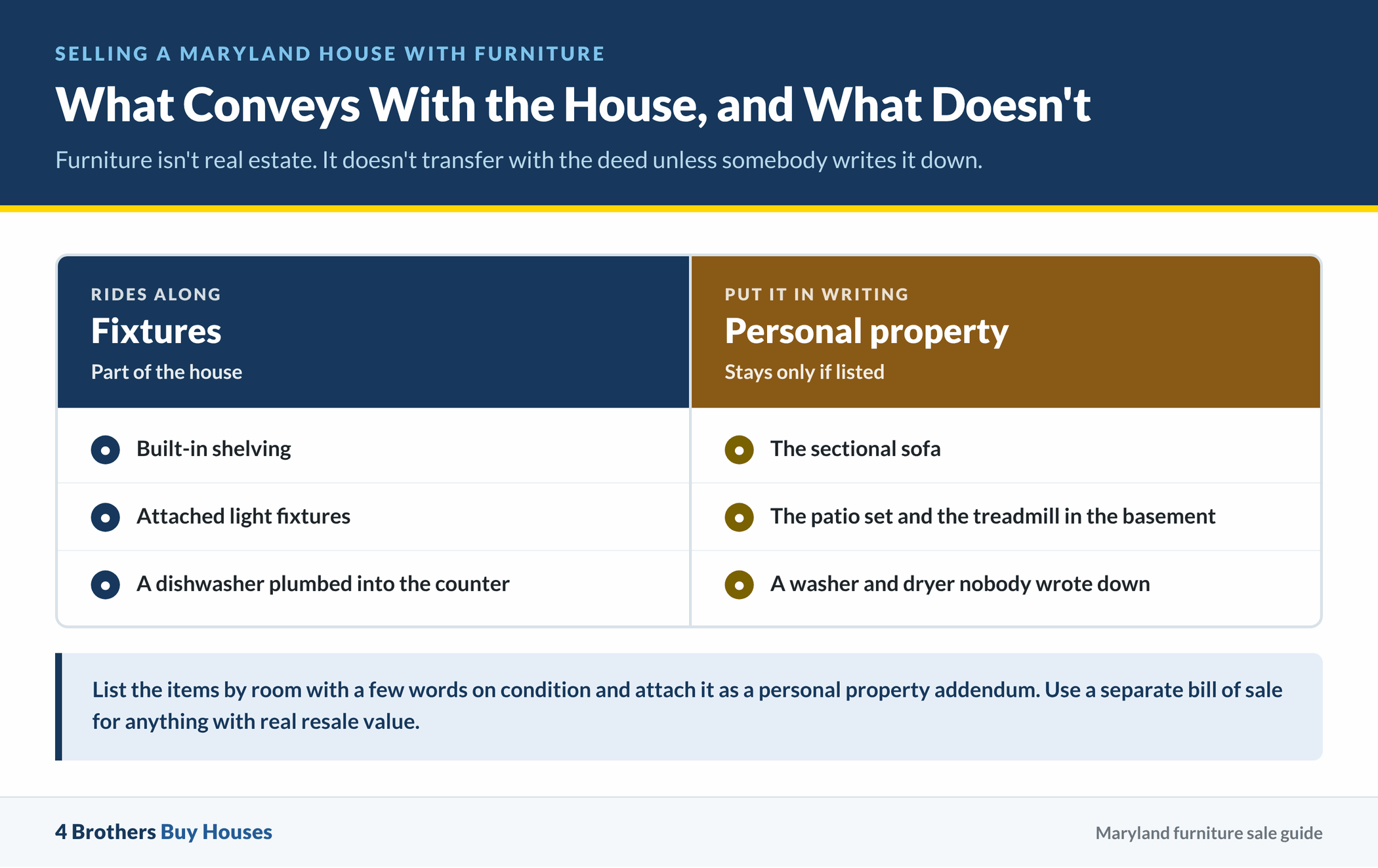
Furniture isn’t real estate, and the law treats it as personal property, so it doesn’t pass with the deed unless someone writes it down. Built-in shelving, attached light fixtures and a dishwasher plumbed into the counter go with the house as fixtures. Freestanding furniture like the sectional sofa doesn’t.
That furniture line starts more arguments at the closing table than almost anything else I see. The buyer remembers the washer and dryer being included, and the seller remembers nothing of the kind. Nobody wrote it down, so now two people are negotiating at the final walkthrough while the movers wait outside.
List the furniture and other items room by room first, with a few words on condition for each. Attach that list to the contract as a personal property addendum. A separate bill of sale keeps the record clean for anything with real resale value. When 4 Brothers Buy Houses buys a house, we spell out the furniture and contents in the agreement so nobody has to guess later.
Does Furniture Change What Your Maryland House Is Worth?
Not by much. Location, condition and equity set the number, and furniture barely registers. In this state, equity and condition don’t move together, and that catches sellers off guard more than price swings do. A worn Baltimore City rowhome and a worn Bethesda colonial can have the same peeling paint and wildly different numbers behind it.
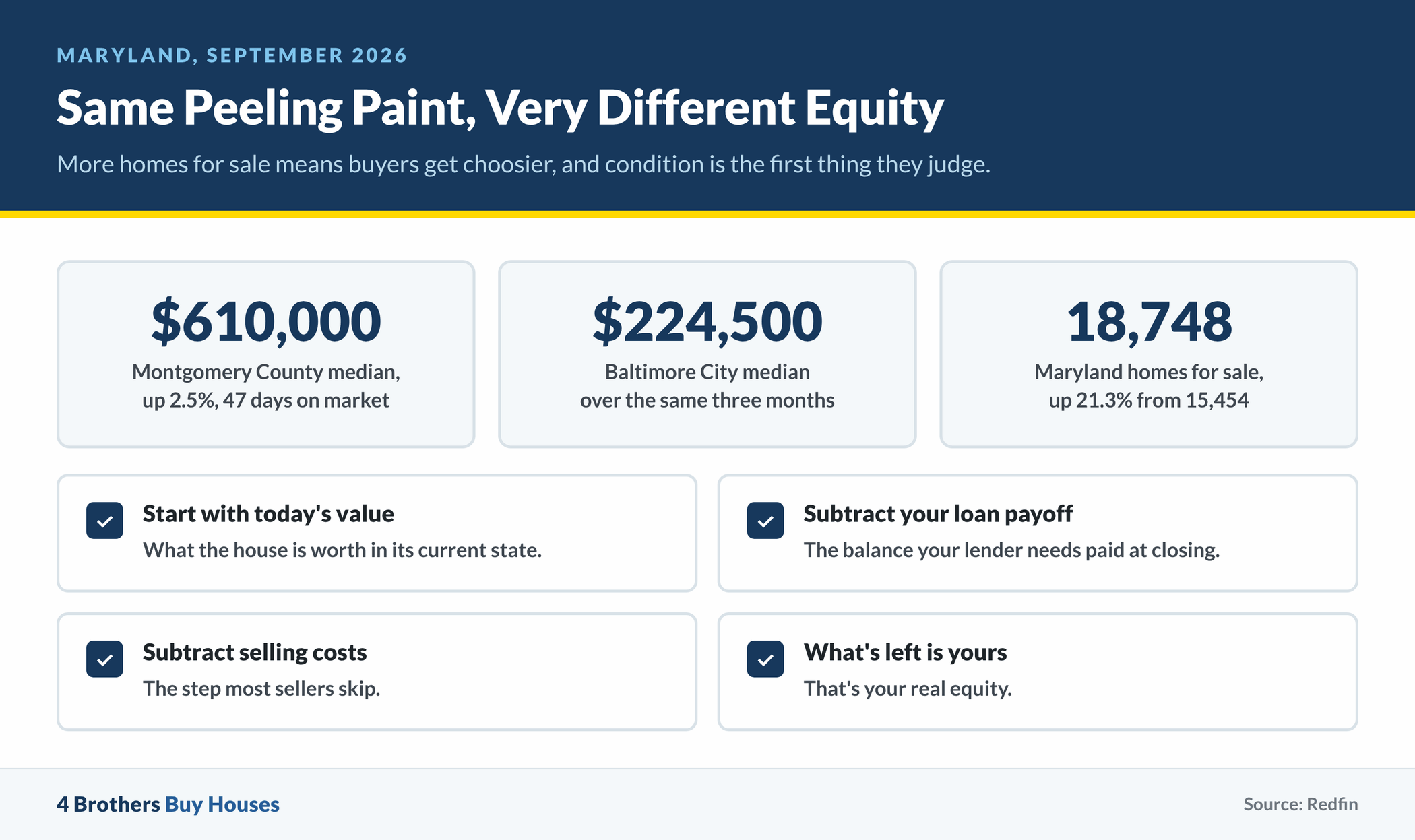
Montgomery County’s median sale price reached roughly $610,000 over the three months ending September 2026. That was up 2.5% from a year earlier, and homes averaged 47 days on market. Baltimore City’s median sat near $224,500 over the same stretch. A Silver Spring homeowner with deferred maintenance often has enough cushion to absorb a repair credit. A Hampden owner with the same leaky roof may not.
Inventory moved as well. Maryland had 18,748 homes available in September 2026, up from 15,454 twelve months earlier, a jump of 21.3%. A more crowded market makes buyers pickier, and condition is the first thing they get picky about.
Working out your real equity takes three steps. Start with a realistic value for the property as it sits today. Subtract your loan payoff, then subtract your selling costs. What’s left is yours. People skip that third step all the time, because the number in their head came from a listing site that assumed granite counters and a finished basement.
Properties in Anne Arundel and Howard counties tend to hold value even when they need work. Townhomes near the D.C. line sell on commute times more than kitchens. Condition counts everywhere, just not equally. A fully furnished house and an empty one with the same problems price about the same to a cash buyer, because furniture barely counts at all.
Can You Sell a Maryland House with Furniture When It Still Has a Mortgage?
That brings up the next question: what if the bank still holds a note on the place? Almost every house I buy has a mortgage attached, and it rarely slows anything down.
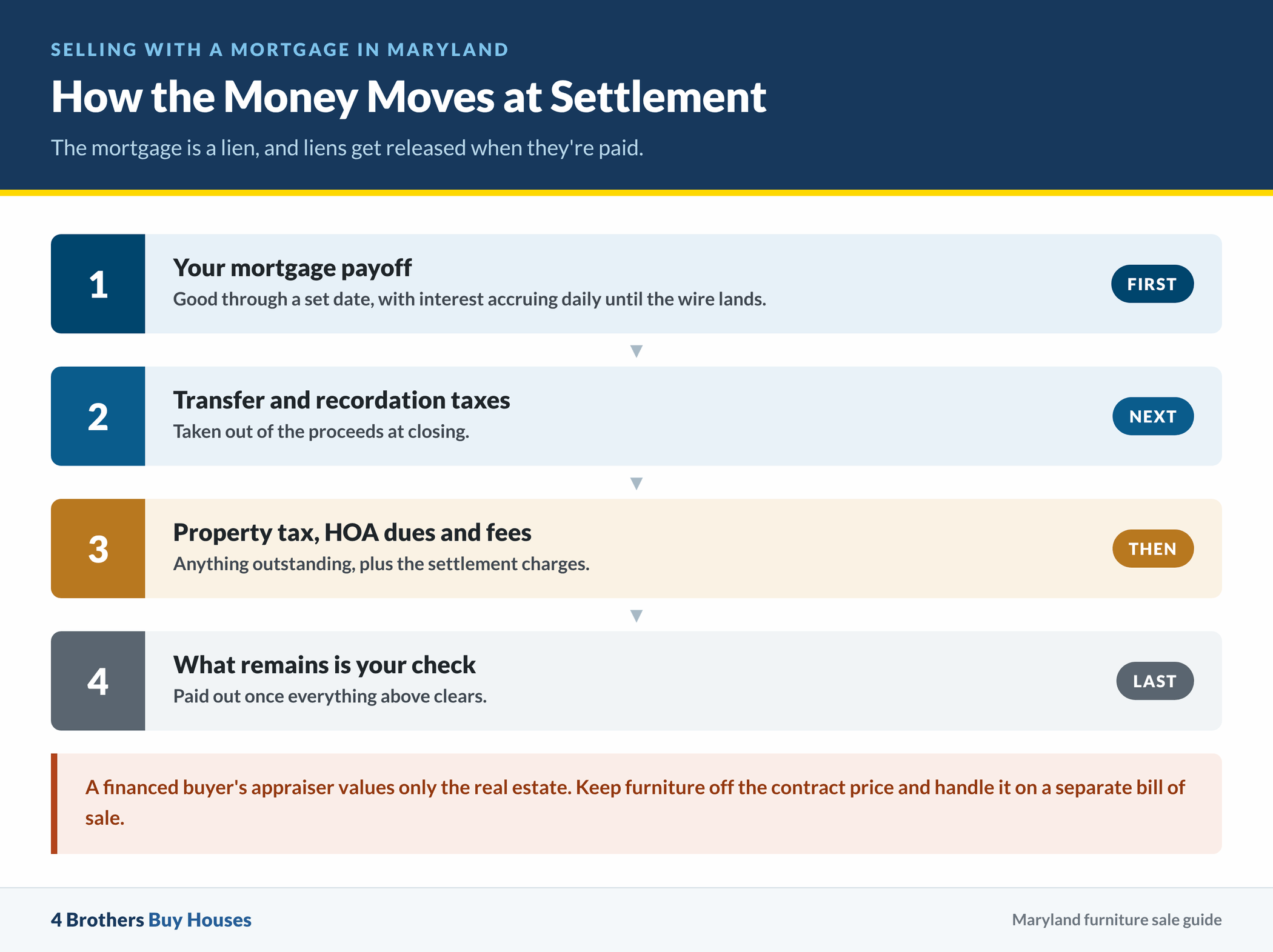
In Maryland, a title company or an attorney runs settlement. They order a payoff statement from your lender that’s good through a specific date. It includes interest that builds daily until the wire lands, and I’ve seen that catch sellers off guard when closing slips a day. At closing, the payoff goes out first. Next come transfer and recordation taxes, any property tax owed, unpaid HOA dues and the settlement fees. Whatever remains is your check.
You don’t need your lender’s permission to sell a house you own on title. The mortgage is a lien, and a lien gets released once it’s paid.
Furniture is where buyers run into trouble. If your buyer is financing, the appraiser values the real estate and nothing more. Furniture and other personal property in the purchase price usually gets backed out before the loan-to-value math, as Redfin’s guide to furnished sales explains. Underwriters don’t like any doubt about what secures their loan, and furniture creates it.
Leave the furniture out of the contract price and put it on a separate bill of sale. Your settlement attorney can set that up in about five minutes, and it’s never once held up a signing on a house I’ve bought. Cash buyers take a house with the furniture still in it and skip that issue entirely, since there’s no appraiser or underwriter to convince.
What If You Owe More Than Your Furnished Maryland House Is Worth?
For years I told underwater sellers to sit tight and wait for prices to rise. That was poor advice for anyone with a job transfer or a divorce decree on the calendar.
Negative equity is rarer in Maryland than it was a decade ago, though it hasn’t disappeared. Recent loans with small down payments, second mortgages and homes with heavy deferred maintenance can all end up there. Properties where a reverse mortgage balance grew past the market value land there too.
You’ve got three paths. You can bring cash to settlement and cover the gap. You ask the lender to approve a short sale and accept less than the full payoff. Or you work out a loan modification and stay put.
A short sale takes patience. The lender wants a hardship letter, your financials and a signed contract before anyone opens the file, and the review runs for weeks. Furniture in the mix clouds that review, since the lender is judging what the real property is worth. Keep the furniture out of the purchase price and the talks stay simpler.
Talk to a tax professional before you sign a short sale approval, because forgiven mortgage debt can carry tax consequences, depending on your situation. An attorney review is money well spent here as well. One afternoon of professional advice costs less than a surprise the next April.
Can You Sell a Furnished Maryland House and Buy Your Next One at the Same Time?
A couple in Columbia found their retirement place on the Eastern Shore and had eleven days to make an offer stick. Their house needed a new HVAC system and held thirty years of furniture, and they couldn’t carry two mortgages.
Timing two transactions is the oldest problem in real estate. If you list, you write a home-of-choice contingency and hope the other seller accepts it. With inventory climbing, that’s more realistic than it was in the frenzy years, though contingent offers still lose to clean ones.
Selling to a cash buyer first takes the pressure off. You know your number, you pick the settlement date, and you shop with money in hand instead of a maybe. Several sellers I’ve worked with closed first and rented back for a few weeks until they closed on the new place.
What matters more to you, the highest possible price or control of the calendar? Those goals pull against each other, and pretending they don’t leads to bad decisions. A listed sale with repairs, staging, inspection talks and appraisal contingencies can net more. It also puts your schedule in someone else’s hands.
Families juggling both ends often land on the simplest route, an as-is sale with the furniture left behind. It takes the cleanout off an already crowded schedule.
Will a Cash Buyer Take Your Maryland House with the Furniture Inside?
Yes, most will. Paying a cleanout crew to empty a furnished house you’re letting go as-is is usually wasted money.
Buyers like us price the property on condition and location, whether it comes empty or with the furniture inside. We handle disposal ourselves, because a crew is already coming through for the renovation. Hauling that furniture to a transfer station yourself won’t raise our offer. It just costs you a Saturday and a rental truck.
Once we’re in the door, we move fast. We walk the house once and check the roof, the basement, the electrical panel and the mechanical systems, then make an offer within a day or two. There’s no inspection contingency, no appraisal and no lender underwriting the contents. Settlement happens at a Maryland title company, and the contract states that the property transfers with the furniture left in place.
Do you get paid for the furniture? Usually not, and you shouldn’t want to. A direct buyer prices the house, covers the removal cost and skips the appraisal problem, which is where sales usually get stuck in my experience buying houses. That trade gets you speed and a clean exit.
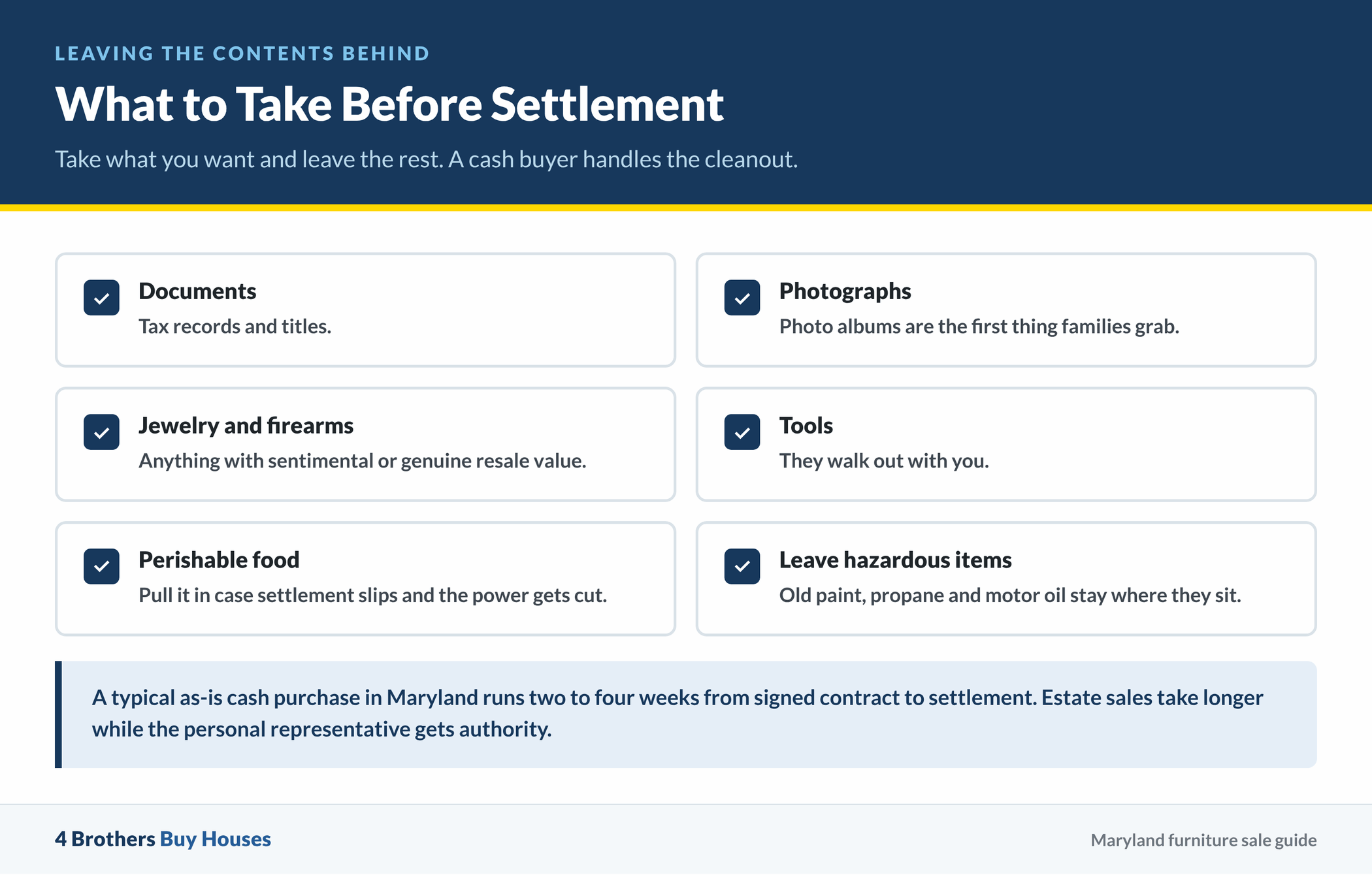
Hang onto two kinds of things: documents, and anything with sentimental or real resale value. Tax records, titles, photographs, jewelry, firearms and tools all leave with you. I’ve watched families find a sealed envelope of savings bonds in a closet two days before settlement.
In Baltimore County, Prince George’s or anywhere along the I-270 corridor, 4 Brothers Buy Houses buys fully furnished houses regularly, and the offer reflects that from the start.
Can You Leave Furniture Behind, and What’s the Timeline for an As-is Maryland Sale?
Take the pieces you want and sell the house with the furniture you don’t. I’d tell my own family the same thing I tell you at your kitchen table.
In Maryland, an as-is cash closing typically takes two to four weeks from signed contract to settlement. From there, the title company sets the pace. It searches the chain of ownership, checks for liens and unpaid taxes, and clears anything outstanding. Estate properties take longer, because the personal representative needs authority from the register of wills before anyone can sign a deed.
Your part is small. You sign the contract, pick a settlement date, pull your belongings and show up with a photo ID.
Last year I bought a split-foyer in Severna Park from a woman whose father had moved into assisted living three months before. His reading chair still faced the window. In the garage, every screwdriver hung on a pegboard outline above his workbench. She kept the tools and the chair, left the rest of the furniture and settled on a Thursday so she could visit him that afternoon with the news.
Nobody should feel guilty about leaving a houseful of things behind. Sorting a lifetime of belongings on a deadline is hard work, and most people are doing it while they handle a funeral, a move across the country or a parent’s care schedule. Walking away from a dining set and the rest of the furniture isn’t a moral failure. It’s a reasonable trade.
Frequently Asked Questions
Do you need to clean the house before settlement?
No. Sweep it if that makes you feel better, though a cash buyer taking a furnished house as-is expects dust, half-full closets and paint cans in the garage. A weekend of scrubbing baseboards won’t change the number on the contract.
What about food in the refrigerator and freezer?
Pull the perishables if you can. That’s less about the contract and more about the smell if settlement slips a week and the power gets shut off. We’ll close with the furniture and everything else still inside.
Can you leave a car, boat or camper on the property?
Only if its title goes with it, and that has to be in writing before settlement. Titled vehicles are handled apart from the real estate. Tell your buyer early so the contract covers it.
What if the house has hoarding conditions or pest problems?
Those houses sell. I’ve bought properties in Dundalk and Hagerstown where we needed respirators to walk the second floor. The offer accounts for the cleanout and remediation, and nobody at the table acts shocked.
Who handles hazardous items like old paint, propane tanks or motor oil?
The buyer does, and Maryland has disposal rules for each one. Leave them where they are instead of hauling cans of unknown chemicals in your back seat.
Does leaving furniture change what you owe at settlement?
No. Your settlement figure comes from the sale price minus any liens, unpaid property taxes and water bills. Furniture isn’t part of the math.
You might be staring at a house full of someone’s furniture with no clear way to handle it. That’s a normal place to be, and you don’t have to solve it this week. A short conversation costs you nothing and usually clears up more than another weekend of sorting boxes. Call when you’re ready, take whatever matters to you and leave the rest to us.
Where We Buy Furnished Houses in Maryland
All over the state, families leave the dining set, the attic and the garage with us. We buy houses in Catonsville, Silver Spring and Dundalk with the furniture still inside. The 4 Brothers Buy Houses team buys across our Maryland service area.
Empty, staged houses get shown before furnished ones. Redfin counted 5,467 Maryland home sales in August 2026, and the typical house sat 43 days on the market before it went under contract.
Leave the Furniture and Get a Number
If the house is full and the calendar is tight, contact us and we’ll price it with the furniture left in place. You can read how our process works before you pack a single box. Fill out the form below to send us the address.
Helpful Maryland Blog Articles
- Selling Partial Ownership Of A House In Maryland
- Tenant Damage vs. Normal Wear And Tear In Maryland Rental Properties
- Who Pays For Appraisal And Inspection In Maryland
- How To Successfully Sell Your House At Auction In Maryland
- Can An Executor Sell Property In Maryland
- Can A Seller Legally Back Out Of A Real Estate Contract In Maryland?
- Selling Your Maryland Home With An Incarcerated Spouse
- Can You Sell a House With Water Damage in Maryland
- How to Sell a House in Foreclosure in Maryland
- Selling a house in probate in Maryland
- How to Sell an Inherited House in Maryland
- Selling A House With Unpermitted Work In Maryland
- When Is the Best Time to Sell a House in Maryland